A Guide to IT Service Management
A Guide to IT Service Management
Key Takeaways:
- This article explores the value and process for IT Service Management services from RubinBrown and the core components of this type of engagement.
- Strategic Alignment – IT services should be intentionally aligned with business goals, so technology investments directly support organizational priorities.
- Process-Driven Approach – Establish and document clear, repeatable practices to manage the full lifecycle of IT services consistently and efficiently.
- Continual Improvement – Regularly measure performance, assess outcomes, and refine processes in an ongoing cycle of improvement.
Nearly 100% of businesses and organizations, including non-profits, healthcare, gaming, manufacturing, construction, higher-education and other industries are using and depend on technology for their day-to-day functions and overall success. Computers, software, applications, mobile phones, and the infrastructure that makes our companies function properly are managed by IT professionals. Information Technology teams, like every profession, can benefit from the guidance, structure, and consistency of proven methodologies. For IT, the best direction is given by IT Service Management (ITSM).
ITSM can help your business:
- Reduce downtime
- Increase revenue
- Improve time-to-market
- Reduce cost Improve customer satisfaction Leverage trends/data to make better decisions Provide insights into the cost of technology
- Manage risk
Quick Definitions
What is IT Service Management (ITSM)?
The strategic practice of designing, delivering, managing and improving IT services to meet business and customer needs through a structured, process-oriented approach focusing on aligning technology with overall organizational goals for efficiency, quality, and value.
What is IT Infrastructure Library (ITIL)?
ITIL is a globally recognized framework of BEST PRACTICES for IT Service Management. Other similar ITSM frameworks include MOF, COBIT, ISO-20000, and FitSM. ITIL provides guidelines for how to manage your IT systems and services. ITSM and ITIL ensure that your IT organization has documented best practices, policies, repeatable processes and procedures to manage the complex and integral systems that are used by the business and, like technology that is constantly changing and improving, these frameworks undergo revisions and enhancements to ensure the best alignment to current and future needs of the business.
Principles of IT Service Management with Examples
- Service-Oriented Delivery– Being “service-oriented” means that an IT organization focuses on delivering a valuable service to the business. IT collaborates with the organization to improve business outcomes (like faster sales, increased production, higher customer satisfaction). Traditionally, IT teams want to highlight technical outputs (like server uptime, Mean Time to Respond (MTTR), ticket closure volumes and service levels), which are important to IT. IT metrics can be translated to provide bigger picture, company-wide perspectives. IT can become a strategic partner and not just a “support function” by emphasizing company efficiency and measurable business value. Example: Designing improvements with the sales team to enhance their systems AND maintain the highest level of uptime ensuring higher sales productivity.
- Business Alignment – IT organizations can ensure that all IT activities directly support business goals such as sales, human resources, marketing, manufacturing, etc. Understanding and aligning technologies to the business departments and defining the criticality of all systems will demonstrate that IT knows what technologies are important to each area of the organization. Example: Creating an end-to-end process with HR, Facilities, Security and all teams that have actions for employee Onboarding to establish an excellent experience for every new hire.
- Process-Driven Operations – By focusing on repeatable processes, IT teams can create consistency to their responses, resolution, delivery, and fulfillment activities. Documented methods and procedures lead to automation. Automation leads to allowing IT team members having time to work on design, development, and improvement initiatives instead of troubleshooting issues. Example: Implementing a PC-loaner program on top of an “auto-provisioning” practice that can build a computer to be offered to employees with issues providing a temporary solution that enables sales, executives, and any employee to quickly continue their daily responsibilities.
Benefits of Implementing ITSM
Applying IT Service Management principles through a structured ITSM implementation ensures that organizations focus on processes, people, technology and data and deliver value to the company and its customers. It streamlines routine tasks like “resetting passwords” to complex decisions such as “upgrading applications” or deploying new AI functionality. Repeatable and documented processes that are technology enabled allow IT teams to think and act more strategically and to apply cost-effectiveness, reliability, and security to the services they provide.
Implementing IT Service Management (ITSM) transitions IT from a "break-fix" support role into a strategic partner that aligns technology with business goals.
Core Business Benefits
- Strategic Business Alignment: ITSM ensures that IT resources are focused on high-value initiatives that support revenue growth and customer experience.
- Cost Reduction & Savings: ITSM lowers operational expenses by centralizing asset tracking, optimizing software/application license usage, and reducing costly downtime through proactive problem management.
- Risk Mitigation & Compliance: Standardized change management processes reduce the risk of service interruptions during updates. It also embeds audit trails and controls necessary for regulatory mandates like HIPAA, SOX, or GDPR.
Operational Benefits (for IT and Business)
- Increased Efficiency & Productivity: Automation of repetitive tasks (like password resets) and the use of AI-assisted triage significantly reduce manual workloads.
- Enhanced User Experience: Self-service portals and knowledge bases empower employees to solve their own minor issues, leading to higher satisfaction for both internal staff and external customers.
- Improved Visibility: Real-time dashboards provide a "single source of truth," allowing leaders to track performance, identify bottlenecks, and make data-backed decisions.
Industries and Organizations that benefit from ITSM
IT Service Management (ITSM) is beneficial for virtually all modern industries, as almost every business now relies heavily on technology for its core operations. Sectors where technology is directly tied to critical services, regulatory compliance, and business continuity have the greatest need for establishing best practices and processes for managing technology.
- Healthcare: Seamless access to electronic health records (EHRs) and reliable clinical systems are critical for patient care. ITSM helps manage incidents efficiently to prevent service disruptions that could impact patient outcomes and ensure compliance with regulations like HIPAA.
- Financial Services: Banks and financial entities depend on secure, high-availability IT services for customer transactions and data processing. ITSM helps mitigate security risks, ensures business continuity for online banking and trading platforms, and maintains compliance with strict financial regulations such as GDPR and the Sarbanes-Oxley Act.
- Manufacturing: Manufacturers rely on IT for automation systems, supply chain management, and production lines. ITSM minimizes downtime, which can have significant financial implications, by monitoring infrastructure and quickly resolving issues with automated machinery and cloud software.
- Government & Public Sector: Public services like emergency systems and online tax portals must be reliable and secure. ITSM ensures the efficient and uninterrupted delivery of these essential services while adhering to stringent security and compliance protocols.
- Retail & E-commerce: Technology manages inventory, point-of-sale (POS) systems, and e-commerce platforms. ITSM ensures system stability during peak shopping periods and improves customer satisfaction by quickly addressing technical issues.
5 Starting Points for Most ITSM Frameworks
Many companies are already focused on key and common IT activities. Applying an ITSM and ITIL framework creates a holistic and integrated approach to really enhance IT and business effectiveness. IT teams that follow these disciplines to manage their services should also have well documented ITSM processes, procedures, and work instructions. Establishing “standards”, defining formal “roles”, and ensuring that your IT team members are following common ITSM practices will streamline their operational activities and ideally will allow them more time to participate in strategic endeavors.
These common IT service management processes are a good foundation for most companies:
- Incident Management Restore service quickly and efficiently by responding to and resolving issues when IT services or components are not working as designed.
- Change Management Follow a procedure of planning, assessing risk, and approving the modifications to existing IT or when introducing new technologies.
- Request Management Improve customer satisfaction by provisioning and delivering any IT Service, hardware, software, data/report, that is requested by your users. Define the services that the company provides in a Service Catalog to ensure compliance and alignment to service level agreements.
- Problem Management Follow a rigorous method that guides IT teams in resolving the root cause of incidents to prevent recurrence. Leverage existing and proven approaches such as 5-Whys, Pareto Analysis, and Ishikawa (Fishbone) Diagrams.
- IT Asset & Configuration Management Maintain inventory with core information throughout the lifecycle of your IT assets with an ITSM tool; your IT team should be tracking financial details and the relationships between the most critical components of IT.
History and Evolution of Information Technology Infrastructure Library (ITIL)
Information Technology Infrastructure Library (ITIL) has undergone significant improvements since its inception more than 30 years ago. It evolved from a set of technical manuals to a robust framework to guide IT and business operations in all aspects of IT service management. At its core, ITIL is a “library” of guidance, concepts, and methodologies that support the broad spectrum of IT management. The holistic best practices can be applied to any and all companies, globally, that depend on technology.
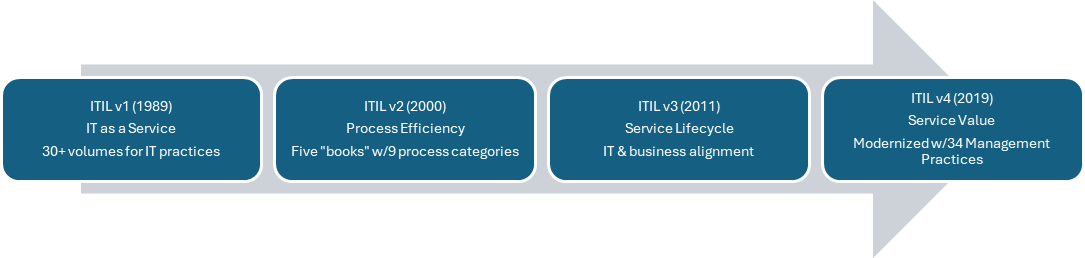
ITSM frameworks will continue to adapt to the world’s ever-changing technology and will align and realign to our business strategies. One of the guiding principles of ITSM and ITIL is to focus on value to the business and ultimately for the customer.
ITSM best practices by category
ITSM frameworks are constantly evolving to support every aspect of the most complex IT environments. Continual Improvement is a key concept for IT and results in ongoing improvement for the business and for customers. The complete and current scope of ITILv4, for example, has evolved to provide guidance and flexible practices that are grouped into General, Service, and Technical Management categories:
General Management |
Service Management |
Technical Management |
Architecture Management Continual Improvement Information Security Management Knowledge Management Measurement and Reporting Organizational Change Management Portfolio Management Project Management Relationship Management Risk Management Service Financial Management Strategy Management Supplier Management Workforce and Talent Management |
Availability Management Business Analysis Capacity and Performance Management Change Enablement Incident Management IT Asset Management Monitoring and Event Management Problem Management Release Management Service Catalog Management Service Configuration Management Service Continuity Management Service Desk Service Level Management Service Request Management Service Validation and Testing |
Deployment Management Infrastructure and Platform Management Software Development and Management |
Summary
RubinBrown Consulting Services can help you get started “where you are at”:
- Assess your current IT, processes, services and/or technologies
- Evaluate current tools
- Optimize the IT organization structure
- Implement new tools/processes/people
- Develop IT Organizational Model
- Define and implement one or more key processes (incident, request, change, problem)
- Design a robust IT Asset and Configuration Management Database (CMDB)
- Standardize/centralize your Service Desk
- Develop a Knowledge Management practice to enable more Self-Service
- Educate the IT department on ITSM Best Practices
- Define a “Request Catalog”
- Define Standard Changes
- Implement a Change Advisory Board (CAB)
- Shift from “firefighting” to strategic IT operations
- Automation & AI
- Event management (consolidate alerts/noise reduction)
- Unify enterprise services (IT, HR, Finance, Facilities, Legal)
- Cross-department coordination (i.e. onboarding/offboarding)
- Define Metrics, KPIs, Dashboards, Reports (drive decisions with data)
- SecOps, security incidents, events
If you are interested in discussing how any of the above could assist your business, feel free to reach out to one of our partners in RubinBrown Consulting Services. We would be delighted to discuss your company's IT Service Management requirements with you.
Published: 03/17/2026
Readers should not act upon information presented without individual professional consultation.
Any federal tax advice contained in this communication (including any attachments): (i) is intended for your use only; (ii) is based on the accuracy and completeness of the facts you have provided us; and (iii) may not be relied upon to avoid penalties.