RubinBrown Sports Betting Index: December 2025 Analysis
RubinBrown Sports Betting Index: December 2025 Analysis
December Sports Betting Index (SBI) - A Market First
In the chart below, we present our RubinBrown Sports Betting Index (SBI). The SBI is based on our proprietary index of the leading sports betting states in the U.S. To continue to best reflect current market conditions, we’ll occasionally adjust the components of the index. To better compare competitive conditions, our index numbers focus in on a group of mature, competitive states. Therefore, a state with an index score of 1.15 had a raw index score of 15% greater than the average, while a 0.90 index score shows a 10% lower than average result.
LEARN MORE ABOUT THE RUBINBROWN SBI
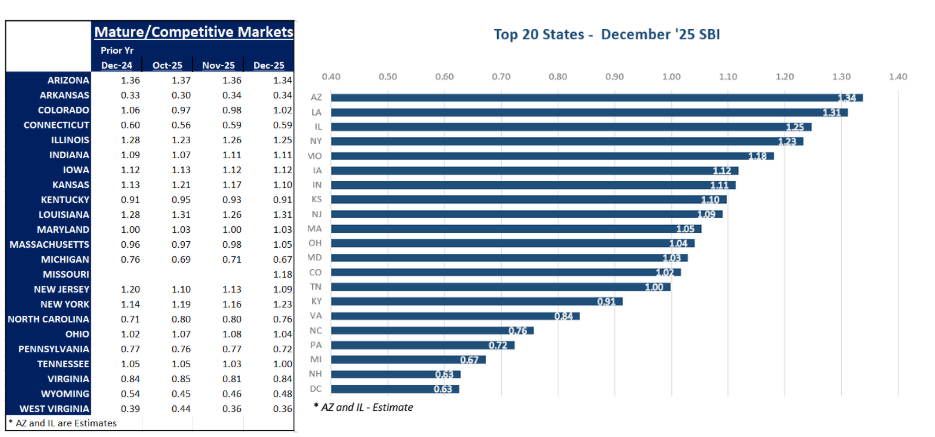
December sports betting results are now in, and they were less than stellar. The data revealed the first year-over-year decline in total sports betting handle since the regulated market began shortly after the repeal of PASPA. This is particularly notable given that December is traditionally one of the highest volume months of the NFL season. Including our estimates for Arizona and Illinois, and excluding Missouri’s inaugural month, December 2025 handle came in at $507m below December 2024, a 3.2% decline.
Our analysis of the marketplace indicates the decline cannot be pinned on a single factor. With multiple structural and market dynamics at play, this month’s results underscore the need for a more nuanced, micro-level approach to interpreting handle trends in mature sports betting markets.
When handle declines are observed, it is tempting to follow the headlines and blame the rise of prediction markets, sweepstakes and DFS alternatives, state tax increases, or other emerging trends. These factors could be contributing factors, but their impact is still unclear.
The Calendar May be to Blame
One key structural consideration to explain the handle drop off was simply the NFL calendar. December 2024 included five Sundays, the league’s prime wagering days, whereas December 2025 had only four. The reduction of even a single high-impact weekend in 2025 could explain some softer overall handle despite a mature, engaged bettor base.
Who Bucked the Trend?
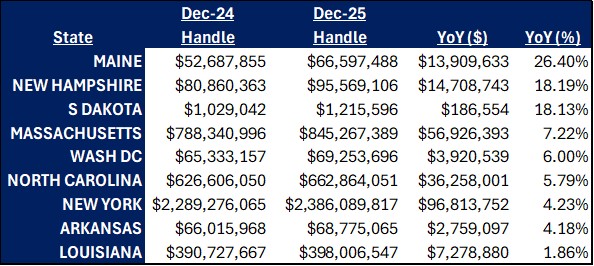
At the state level, the picture is equally unclear. While most states experienced declines, 9 jurisdictions bucked that trend with mostly modest gains. The chart below reveals the 9 states that were able to post year-over-year increases. There are usually broader trends in mature markets: team-level performance and micro-factors can significantly amplify or dampen local betting activity.
As we look at the deepest YoY declines, another anomaly came to the forefront. Of the eight largest percent declines (highlighted below), six of the seven states with iGaming appeared.
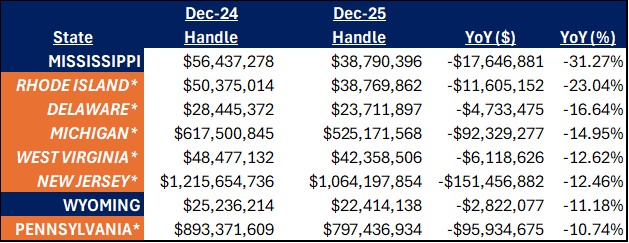
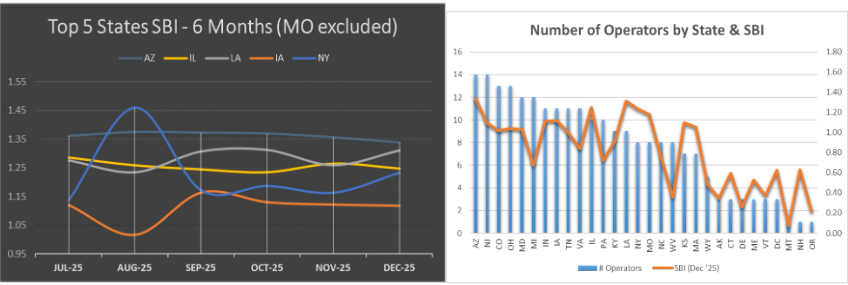
Our SBI has long shown that many of the iGaming states underperform in sports betting. There is likely some causation where some participants find they prefer spending more of their gaming budgets on online casino instead of sports betting. While sports betting is quite healthy in these states, the growth of online casino revenues far outpaces sports betting growth in the states which offer both.
The Missouri Effect
With the launch of Missouri’s legal market, it was expected that border crossing bettors would repatriate from Kansas and Illinois to their home state. Illinois has yet to report, but clues as to the impact on Kansas were readily apparent. As mentioned in our previous report on Missouri’s launch, $534m was wagered in the Show Me State’s first month of operations.
Significant bonuses for patrons could have drawn some Kansas and Illinois residents to participate in Missouri’s first month of operations. However, we believe Missouri’s first month of activity included newly induced activity from those who were minimally or not participating in the prior year.
Kansas handle followed the downward trend with a YoY decrease of nearly 8%. While that alone is significant, our SBI further revealed that their relative decrease versus other states was also formidable. Kansas’ SBI declined from 1.17 to 1.10. This shows that even in a declining market, Kansas’ retreat was larger than most.
We also note the Chiefs early exit from playoff contention. The NFL’s most followed team in past seasons saw it’s highly popular quarterback injured for most of the month. This likely had impacts on not only Kansas activity, but nationwide betting handle. While hard to quantify, we believe such changes lead to short-term adjustments in betting activity as patrons take time to find new favorite teams and players to back.
The Story Is Yet To Be Written
For operators, investors, and regulators, these insights reinforce the importance of looking beyond headline totals. In addition to noted macro issues at play, we also focus on the underlying structural and local factors that drive wagering behavior. As the industry continues to evolve, a thorough micro-level perspective will remain essential for interpreting results, optimizing strategy, and anticipating future market dynamics.
Published: 02/12/2026
Readers should not act upon information presented without individual professional consultation.
Any federal tax advice contained in this communication (including any attachments): (i) is intended for your use only; (ii) is based on the accuracy and completeness of the facts you have provided us; and (iii) may not be relied upon to avoid penalties.