RubinBrown Sports Betting Index: February 2026 Analysis
RubinBrown Sports Betting Index: February 2026 Analysis
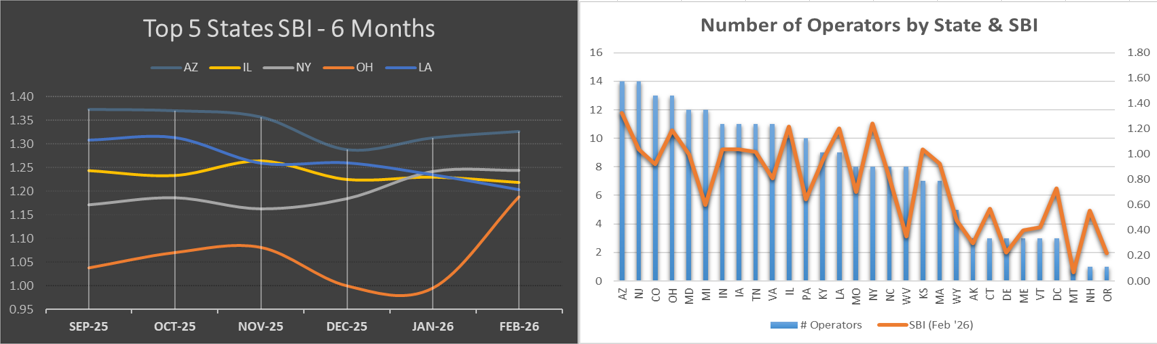
In the chart below, we present our RubinBrown Sports Betting Index (SBI). The SBI is based on our proprietary index of the leading sports betting states in the U.S. To continue to best reflect current market conditions, we’ll occasionally adjust the components of the index. To better compare competitive conditions, our index numbers focus in on a group of mature, competitive states. Therefore, a state with an index score of 1.15 had a raw index score of 15% greater than the average, while a 0.90 index score shows a 10% lower than average result.
LEARN MORE ABOUT THE RUBINBROWN SBI
U.S. Sports Betting Optimism in the Face of Headwinds
February sports betting results reinforce a trend the RubinBrown team has been highlighting for months: the U.S. regulated market is transitioning from rapid expansion to stabilization. National handle was essentially flat year over year ($12.5B vs. $12.4B, excluding Missouri), marking the third consecutive month without meaningful growth and signaling a shift toward a more mature, baseline market.Even the most recent launch state, Missouri, illustrates this dynamic. After opening in December with strong early momentum and a RubinBrown Sports Betting Index Score of 1.18, which is 18% above the average competitive market, activity normalized quickly. Handle declined to an index of 0.80 in January and 0.70 in February, pointing to early saturation and reinforcing the limits of first-wave expansion in newly legalized states.
.png "Feb26-SBI-(4).png")
These trends, however, should not be interpreted as “doom and gloom.” A more constructive view places them within a broader macroeconomic context. While prediction markets and alternative platforms may be capturing a small share of low-margin, single-game wagers, their full impact has yet to be determined. More influential are broader economic pressures. Recent data suggests only modest gains in real purchasing power, while persistent cost pressures and geopolitical uncertainty continue to weigh on discretionary spending.
Against this backdrop, flat year-over-year handle is better understood not as a warning sign, but as evidence of underlying resilience. If the industry has entered a more mature phase heading into the remaining months of 2026, the ability to sustain steady engagement amid broader economic caution points to a durable, normalized market base rather than any indication of structural decline.
Importantly, the underlying consumer segments remain intact. Casual bettors, who drove much of the industry’s early growth, continue to participate, albeit at slightly lower frequency and spend levels. Notably, this engagement has persisted even in the absence of outsized promotional incentives, signaling a more organic and sustainable level of demand. Should economic conditions improve, this cohort may represent a source of pent-up growth.
Viewed through this lens, the current environment reflects a market sustaining broad engagement despite incremental economic constraints. In fact, the alternative scenario, rapid growth amid tightening household budgets, could signal unhealthy or unsustainable behavior. Instead, current trends suggest that consumers are engaging with legalized sports betting in a measured and responsible way, a positive indicator for long-term industry health.
Whether driven by responsible gaming initiatives, evolving consumer attitudes, or the natural progression of a maturing market, the evidence points to a more balanced trajectory ahead. While runaway growth may no longer define the U.S. sports betting landscape, sustained, stable participation is a far stronger foundation for long-term success.
Published: 04/09/2026
Readers should not act upon information presented without individual professional consultation.
Any federal tax advice contained in this communication (including any attachments): (i) is intended for your use only; (ii) is based on the accuracy and completeness of the facts you have provided us; and (iii) may not be relied upon to avoid penalties.