RubinBrown Sports Betting Index: January 2026 Analysis
RubinBrown Sports Betting Index: January 2026 Analysis
January Sports Betting Index (SBI)
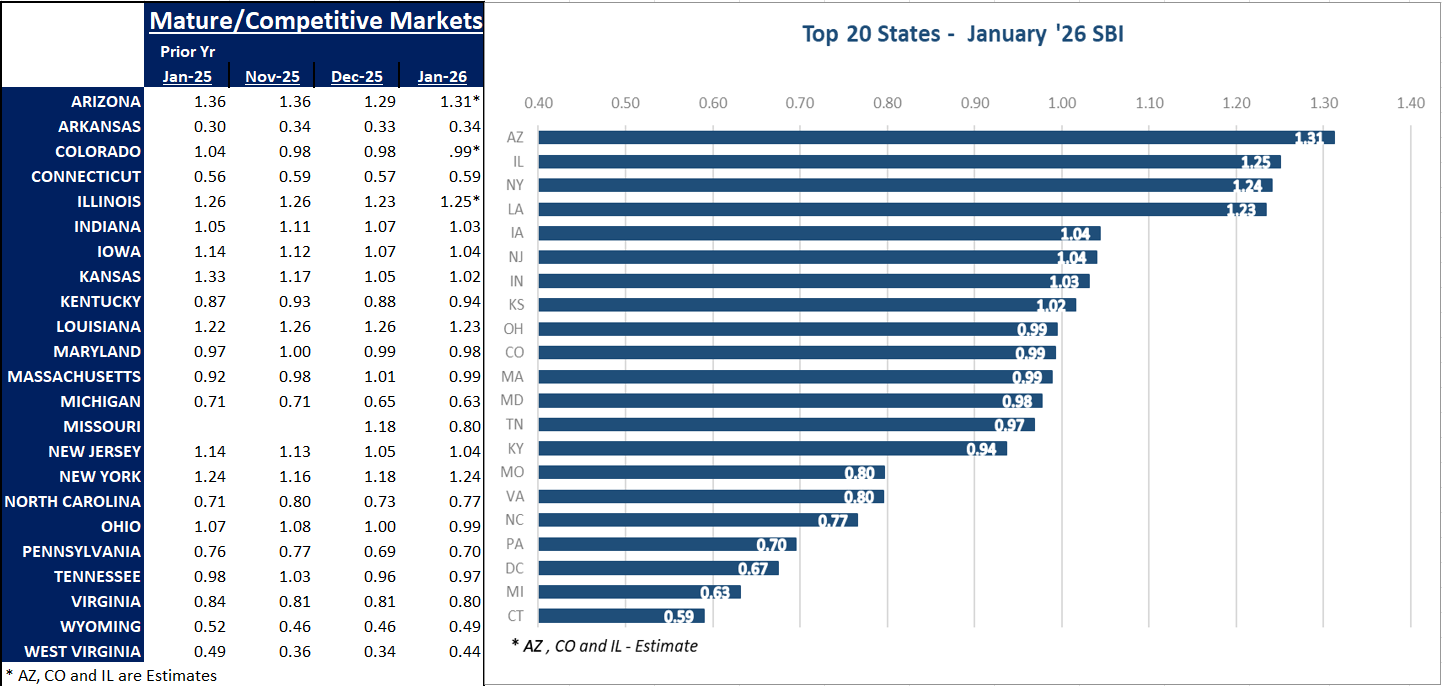
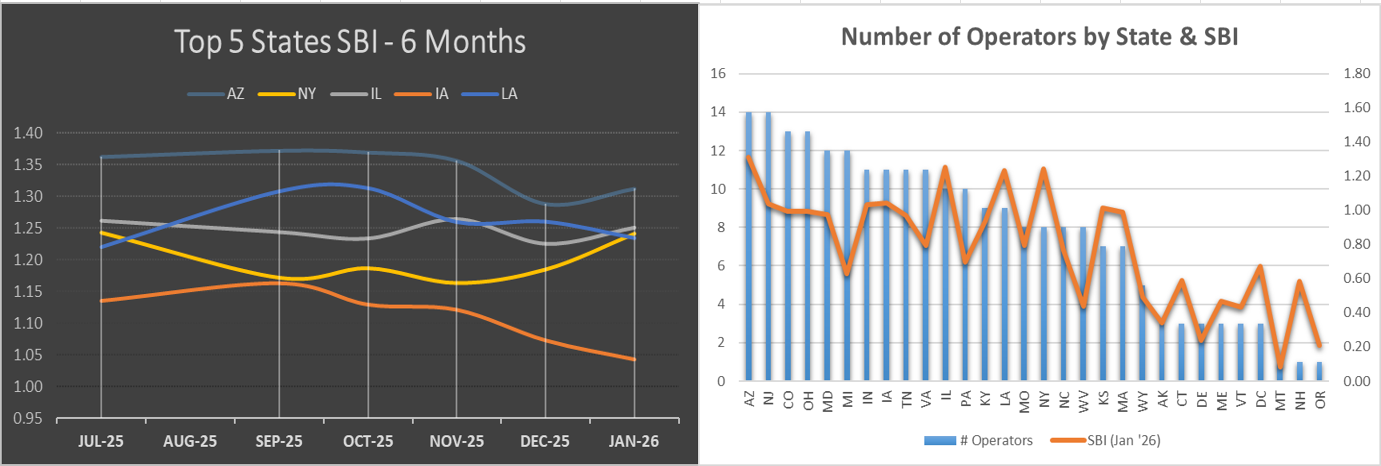
In the chart below, we present our RubinBrown Sports Betting Index (SBI). The SBI is based on our proprietary index of the leading sports betting states in the U.S. To continue to best reflect current market conditions, we’ll occasionally adjust the components of the index. To better compare competitive conditions, our index numbers focus in on a group of mature, competitive states. Therefore, a state with an index score of 1.15 had a raw index score of 15% greater than the average, while a 0.90 index score shows a 10% lower than average result.
LEARN MORE ABOUT THE RUBINBROWN SBI
Narrative: Declining Handle, Expanding Margins — and a Structural Shift in the Mix
The U.S. sports betting market entered 2026 reaching a potential inflection point. December 2025 recorded the first year-over-year (YoY) decline in national handle of the modern regulated era, and January 2026 followed with a second consecutive contraction. However, gross gaming revenue (GGR), remained firm in both months. This has led to less concern for the trend in handle. However, we remain vigilant in watching this indicator.
The divergence between handle and hold defines the industry’s current phase: wagering volume may be plateauing, even as margin performance strengthens. This likely signals a market that is maturing and shifting from rapid expansion toward operational optimization. Organic growth in established jurisdictions has decelerated. Promotional intensity has normalized. The land-grab phase may have concluded.
Hold versus Revenue debate enters the picture again
Most mainstream coverage has focused on rising GGR and expanding state tax collections which framed December and January as positive outcomes. From a fiscal perspective, that emphasis is logical: gaming taxes are calculated on revenue, not handle.
However, widening margins alone may not define durable growth. If handle contracts, GGR may eventually follow. A rise in hold may reflect favorable outcomes or a higher-margin product mix rather than stronger underlying demand. The distinction is critical.
Decoupling in Action: State Markets with Expanding Hold
Here are selected states which illustrate the trend of rising GGR despite declining handle:
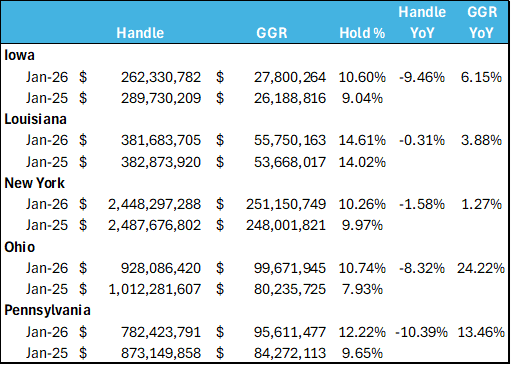
What may happen if a decline in hold converges with new levels of handle, with revenues following the decline? And if tax revenues regress, how might states react after becoming accustomed to funding their initiatives on the back of sports betting taxes?
Product Mix: How Revenue Rises While Volume Falls
Historically, straight (single-game) wagers generate long-term hold in the 4–6% range. These bets are price-sensitive and trade in relatively efficient markets. By contrast, modern operators have leaned heavily into parlays supported by dynamic pricing models, where blended hold percentages can approach or exceed 20%. Compounded probabilities and embedded pricing edges materially increase margins with each added leg. Most patrons seem oblivious to such shifts, content to shift more of their action to small parlay bets with a large payoff on the rare occasions when they hit.
As product mix continues to shift toward higher-margin parlays, operators can generate equal or more revenue from lower total handle. If overall handle declines but the remaining volume skews toward parlays, revenue can still rise provided there is an accompanying increase in hold percentage.
While this sounds like the ideal trend that operators will continue to strive for, one must question how sustainable this is. Namely, will patrons continue to pursue sports betting with the same vigor if they find themselves winning infrequently?
A Market Now Defined by Efficiency
December 2025 and January 2026 results may mark a structural transition. The industry is no longer defined by geographic expansion and aggressive promotional scaling. For operators, this is a profitability evolution. For regulators, it is a tax revenue narrative.
Should this evolution continue positively for operators, then the industry will look relatively healthy. If changes in customer activity leads to a further retreat in handle, there could be negative consequences for the industry.
While “wait and see” is required for revenue trends, we do maintain that changes in handle often predict future trends. If handle softness persists while hold remains elevated, the durability of that balance will define the next phase of U.S. sports betting. The headline numbers suggest strength. The volume trend signals maturation.
Understanding the widening gap between the two is now essential to evaluating the industry’s trajectory.
Published: 03/11/2026
Readers should not act upon information presented without individual professional consultation.
Any federal tax advice contained in this communication (including any attachments): (i) is intended for your use only; (ii) is based on the accuracy and completeness of the facts you have provided us; and (iii) may not be relied upon to avoid penalties.