Back to Insights
RubinBrown Sports Betting Index: April 2026 Analysis
RubinBrown Sports Betting Index: April 2026 Analysis
April Sports Betting Index (SBI)
In the chart below, we present our RubinBrown Sports Betting Index (SBI). The SBI is based on our proprietary index of the leading sports betting states in the U.S. To continue to best reflect current market conditions, we’ll occasionally adjust the components of the index. To better compare competitive conditions, our index numbers focus in on a group of mature, competitive states. Therefore, a state with an index score of 1.15 had a raw index score of 15% greater than the average, while a 0.90 index score shows a 10% lower than average result.
LEARN MORE ABOUT THE RUBINBROWN SBI
Yet sports betting performance remains far from uniform.
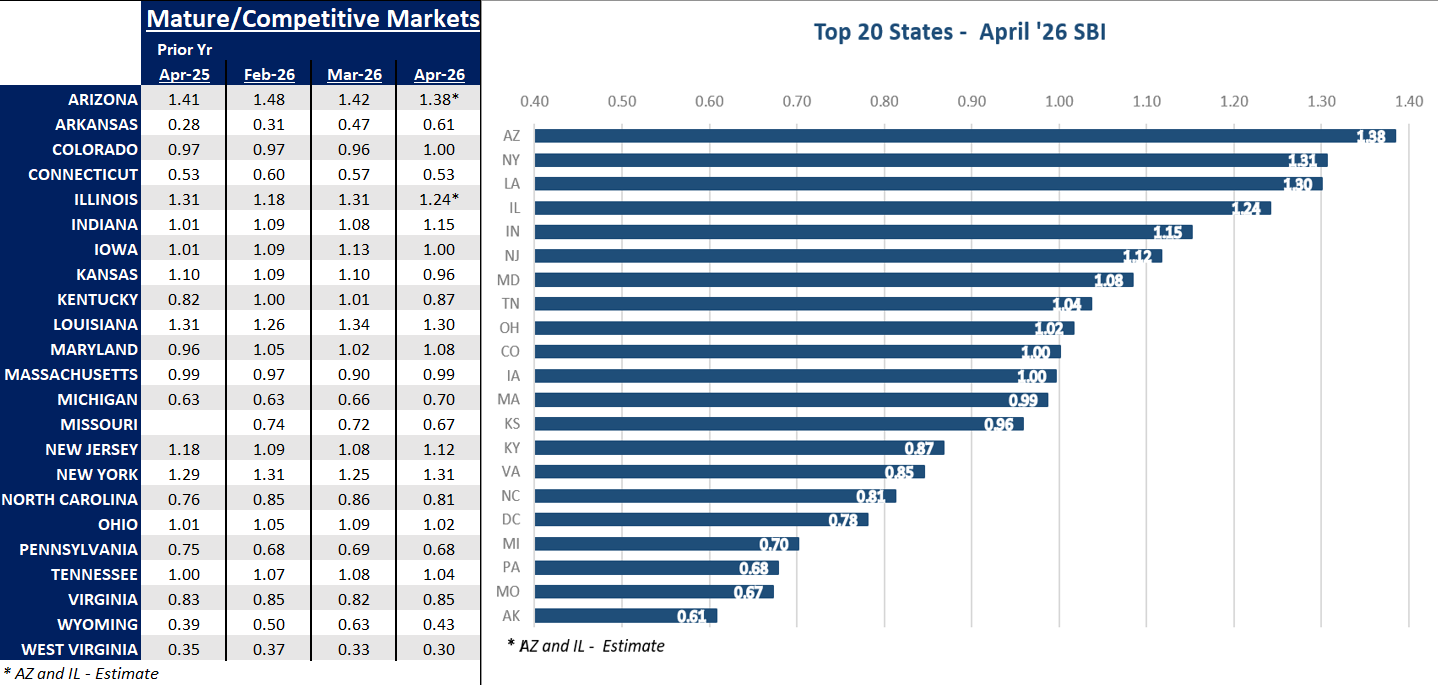
The RubinBrown Sports Betting Index (SBI), which measures sports betting activity relative to a proprietary blend of market metrics, continues to show substantial variation among states. Some jurisdictions consistently generate handle well above expectations, while others fail to convert favorable demographics and gaming infrastructure into comparable wagering activity.
These differences suggest that states may still influence sports betting outcomes through the gaming ecosystems they continue to invest and build before and alongside the launch and growth of sports betting.
By contrast, some notable SBI underperformers have built ecosystems centered around online casino gaming. Pennsylvania and Michigan, for example, are among the nation's most successful iGaming markets and generate substantial online casino revenue. However, both have generally underperformed in sports betting relative to their population, professional sports assets, and broader gaming infrastructure.
This raises an important question: does a sports-centric ecosystem drive stronger sportsbook engagement, while other gaming verticals compete for consumer attention and wallet share?
The strongest sports betting markets tend to share several characteristics:
✓ Concerted effort on the success of sports betting
✓ Established DFS participation
✓ Sports-focused digital engagement
✓ Competitive sportsbook environments
✓ High mobile adoption
✓ Strong customer retention
Conversely, several leading iGaming jurisdictions have produced sports betting results that appear modest relative to their overall gaming potential.
This does not necessarily mean iGaming harms sports betting. Rather, different focus on forms of online gaming versus forms of sports gaming may influence consumer behavior differently. DFS is directly tied to sports consumption and may function as a natural feeder system for sportsbooks. Online casino gaming, while highly profitable, may compete more directly for consumer time and discretionary gaming dollars.
For regulators seeking to understand why some states consistently outperform expectations while others fall short, the answer may lie less in demographics and more in the acceptance of the regulated gaming ecosystem that existed long before the first legal sports wager was placed.
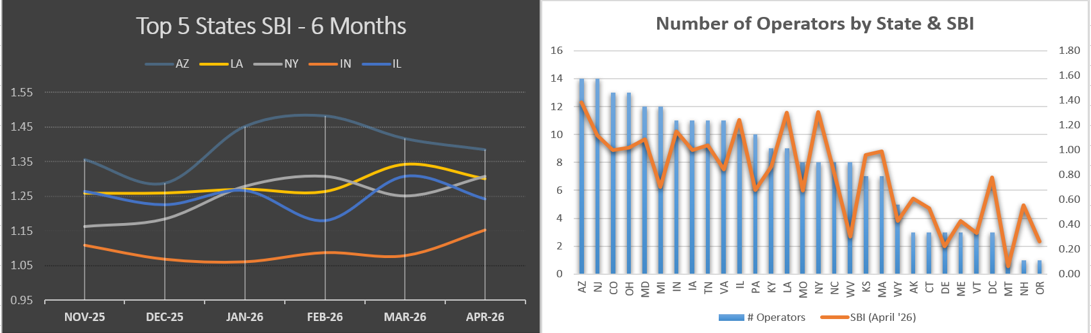
In the chart below, we present our RubinBrown Sports Betting Index (SBI). The SBI is based on our proprietary index of the leading sports betting states in the U.S. To continue to best reflect current market conditions, we’ll occasionally adjust the components of the index. To better compare competitive conditions, our index numbers focus in on a group of mature, competitive states. Therefore, a state with an index score of 1.15 had a raw index score of 15% greater than the average, while a 0.90 index score shows a 10% lower than average result.
LEARN MORE ABOUT THE RUBINBROWN SBI
Can States Still Influence Sports Betting Handle?
As Arkansas recently opened its market to FanDuel and DraftKings and immediately experienced a significant increase in handle, it served as another reminder that a state's gaming ecosystem can materially influence sports betting performance. In the early years of legalization, market results were heavily driven by launch timing, promotional spending, operator investment, and market access. Today, most major operators have nationwide footprints, customer acquisition has stabilized, and the industry has shifted from rapid expansion to competition for market share.Yet sports betting performance remains far from uniform.
The RubinBrown Sports Betting Index (SBI), which measures sports betting activity relative to a proprietary blend of market metrics, continues to show substantial variation among states. Some jurisdictions consistently generate handle well above expectations, while others fail to convert favorable demographics and gaming infrastructure into comparable wagering activity.
These differences suggest that states may still influence sports betting outcomes through the gaming ecosystems they continue to invest and build before and alongside the launch and growth of sports betting.
The Emerging Divide: DFS States vs. iGaming States
Many of the highest-performing SBI states entered the sports betting era with established daily fantasy sports (DFS) markets and years of consumer engagement with sports-focused digital gaming products. Arizona, Indiana, Iowa, Kansas, and Louisiana all benefited from meaningful DFS participation before sportsbooks launched. These states developed customer bases already familiar with:- Mobile account registration
- Electronic payments
- Geolocation technology
- Statistical analysis and player research
- Bankroll management
- Sports-focused digital engagement
By contrast, some notable SBI underperformers have built ecosystems centered around online casino gaming. Pennsylvania and Michigan, for example, are among the nation's most successful iGaming markets and generate substantial online casino revenue. However, both have generally underperformed in sports betting relative to their population, professional sports assets, and broader gaming infrastructure.
This raises an important question: does a sports-centric ecosystem drive stronger sportsbook engagement, while other gaming verticals compete for consumer attention and wallet share?
What the SBI Leaders Tell Us
Arizona: The Gold Standard
Arizona consistently ranks among the strongest SBI performers despite competing against larger states with more established gaming industries. Its advantages include:- Strong DFS participation prior to legalization
- Teams in all four major professional sports leagues
- MLB Spring Training, PGA Tour events, and NASCAR
- Rapid population growth
- Significant migration from highly engaged sports-centric states
- A competitive regulatory structure
Iowa: A Case Study in Engagement
Despite lacking a major professional sports franchise and having a relatively small population, Iowa consistently generates sports betting engagement levels that exceed expectations. Key factors include a strong college sports culture and early DFS adoption. If handle were primarily a function of market size, Iowa would not rank among the industry's strongest performers.What the Underperformers Tell Us
Pennsylvania
Pennsylvania possesses many attributes traditionally associated with sports betting success:- Seven major professional sports franchises
- Extensive gaming infrastructure
- Legal iGaming
Michigan
Michigan presents a similar pattern. The state features:- Four major professional sports franchises
- One of the nation's largest iGaming markets
- Significant overall gaming revenue
Can States Shape Sports Betting Outcomes?
The SBI data increasingly suggests they can. While states cannot change their population or instantly create professional sports franchises, they can influence the broader gaming ecosystem through regulatory decisions, licensing frameworks, and the types of gaming products they authorize.The strongest sports betting markets tend to share several characteristics:
✓ Concerted effort on the success of sports betting
✓ Established DFS participation
✓ Sports-focused digital engagement
✓ Competitive sportsbook environments
✓ High mobile adoption
✓ Strong customer retention
Conversely, several leading iGaming jurisdictions have produced sports betting results that appear modest relative to their overall gaming potential.
This does not necessarily mean iGaming harms sports betting. Rather, different focus on forms of online gaming versus forms of sports gaming may influence consumer behavior differently. DFS is directly tied to sports consumption and may function as a natural feeder system for sportsbooks. Online casino gaming, while highly profitable, may compete more directly for consumer time and discretionary gaming dollars.
The Policy Question for the Next Decade
As sports betting enters a more mature phase, policymakers may need to focus less on legalization and more on ecosystem development. The SBI leaders suggest that states can still influence sports betting handle, not necessarily through tax rates or licensing fees, but through the broader digital gaming environment they create. States that cultivate sports-centric engagement through products such as DFS may be building a more engaged and loyal sports bettor. States that prioritize broader gaming expansion may maximize total gaming revenue, but not necessarily sports betting performance.For regulators seeking to understand why some states consistently outperform expectations while others fall short, the answer may lie less in demographics and more in the acceptance of the regulated gaming ecosystem that existed long before the first legal sports wager was placed.
Published: 06/17/2026
Readers should not act upon information presented without individual professional consultation.
Any federal tax advice contained in this communication (including any attachments): (i) is intended for your use only; (ii) is based on the accuracy and completeness of the facts you have provided us; and (iii) may not be relied upon to avoid penalties.