Back to Insights
RubinBrown Sports Betting Index: March 2026 Analysis
RubinBrown Sports Betting Index: March 2026 Analysis
March Sports Betting Index (SBI)
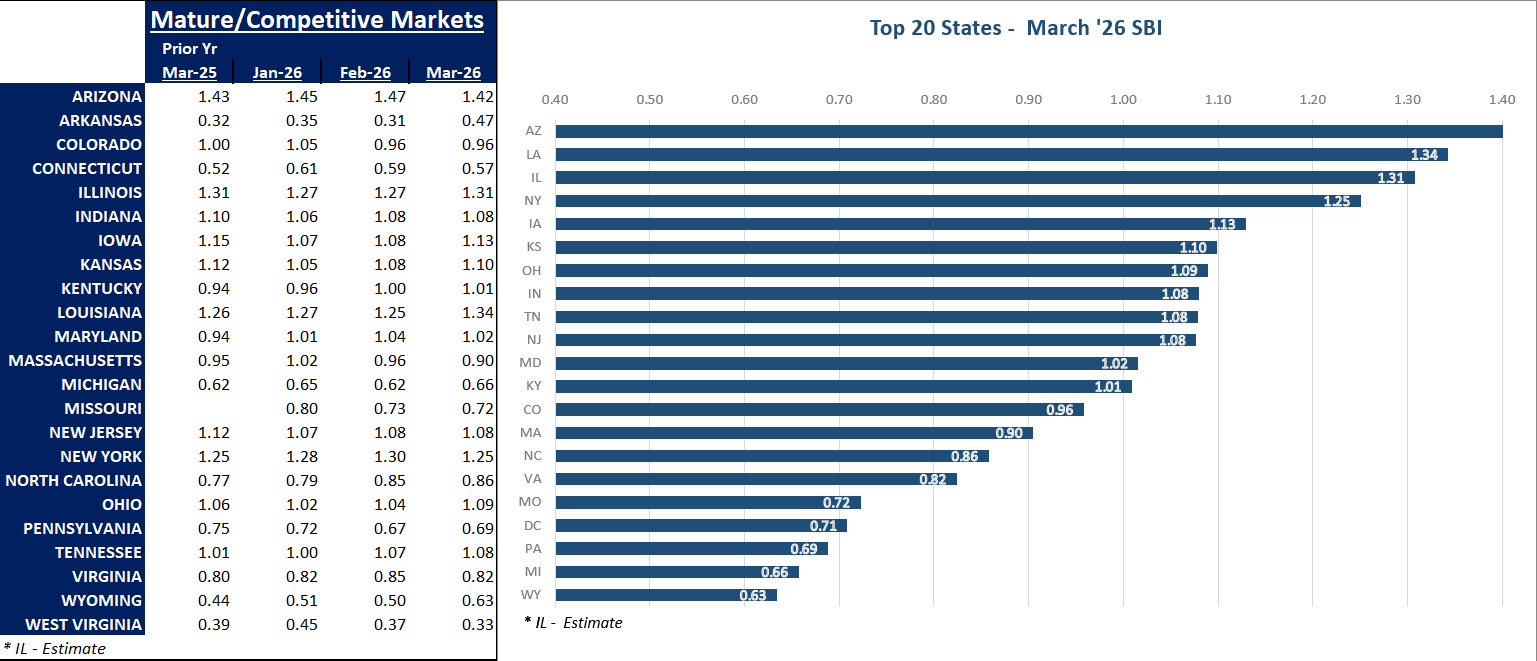
In the chart below, we present our RubinBrown Sports Betting Index (SBI). The SBI is based on our proprietary index of the leading sports betting states in the U.S. To continue to best reflect current market conditions, we’ll occasionally adjust the components of the index. To better compare competitive conditions, our index numbers focus in on a group of mature, competitive states. Therefore, a state with an index score of 1.15 had a raw index score of 15% greater than the average, while a 0.90 index score shows a 10% lower than average result.
LEARN MORE ABOUT THE RUBINBROWN SBI
Nationwide, the downward trajectory of handle continued with a monthly total year-over-year decline of roughly 3.8% (adjusting for new market entrant, Missouri). For the third consecutive month, growth wasn’t being supported by expansion or a surge of new users.
But neither operators nor tax collectors had reason for alarm. From their perspective, the numbers looked fine. Total handle neared $15 billion when factoring in estimates from slower-reporting states, and basketball betting surely contributed heavily to that total. Ignoring handle, several major markets posted solid revenue results, supported by strong hold and favorable product mix. Pennsylvania, for instance, posted a 13.3% handle decrease, but a 37.6% INCREASE in hold. New York followed suit with a handle decline of 4.7% but a 34.2% increase in hold. In spite of an abundance of player friendly results, the month delivered for the industry.
It does beg the question; could it be that exchange-style platforms and prediction markets are beginning to absorb portions of lower-margin activity, particularly straight wagers that have historically contributed less to sportsbook profitability? Bettor behavior at sports books shows steady participation, but trending towards smaller average wagers, reinforcing the “bet small to win big” mentality of many parlay bettors.
Interesting to note, these positive results occurred in the face of player friendly single game outcomes. As the tournament played out, betting interest wasn’t lacking; engagement remained strong. What was missing was disruption. Higher-seeded teams won early and often, including a rare clean sweep on the opening Friday. That trend carried forward, with few meaningful upsets to reset the bracket in a meaningful way.
For sportsbooks, the impact may have been subtle. In a market increasingly driven by parlays and correlated wagers, results don’t just resolve independently, they build on each other. When favorites win in clusters, winning bets don’t simply settle, they await future results. However, all it takes is one unexpected result and many promising wagers settle as worthless.
In past years, early upsets acted as a reset point. They reduced liability and helped rebalanced positions. However, this year the tournament moved forward without a day of mass upsets, which could have led to a new set of wagers and more handle being pumped into the ecosystem. In the end, this might have been a goldilocks moment for the industry as patrons got their money’s worth in entertainment value, even if their bets settled as losses. Meanwhile, the sports books got the money in the end even though they might have been fretting over a worse outcome if the occasional surprise didn’t come to wipe out growing short-term liabilities.
At the same time, the structure of the market has changed. Sportsbooks are no longer focused primarily on balancing straight bets. Instead, they are managing portfolios of interconnected positions, many designed to drive higher margins through multi-leg and same-game wagers. That approach has improved profitability, but it has also increased sensitivity to clustered results. The same structure that enhances margins can amplify exposure when outcomes move together.
These shifts don’t suggest decline. They point to a market in transition. The industry remains large and, in many cases, still growing from a revenue perspective. But the source of that growth is evolving. It is becoming less about volume and more about structure, and about what could happen if most or all outcomes resolve in the same direction.
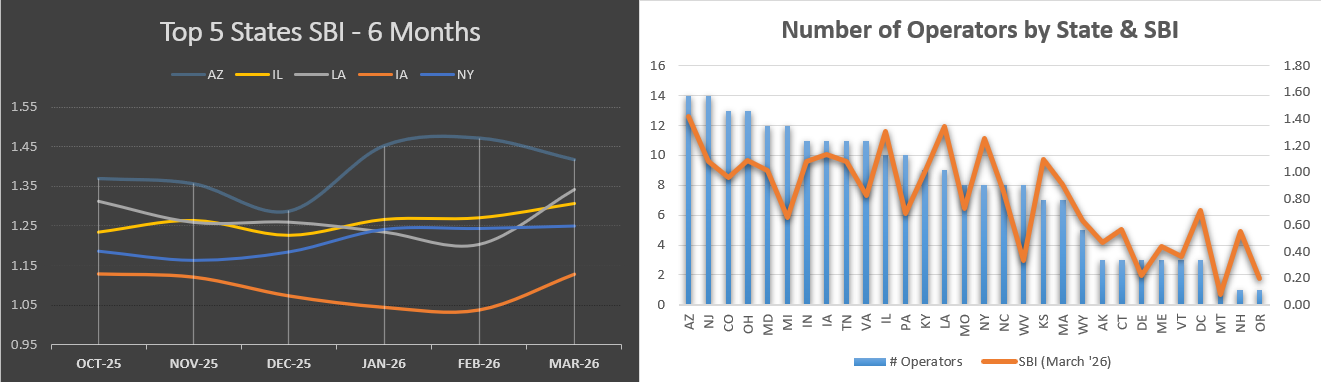
In the chart below, we present our RubinBrown Sports Betting Index (SBI). The SBI is based on our proprietary index of the leading sports betting states in the U.S. To continue to best reflect current market conditions, we’ll occasionally adjust the components of the index. To better compare competitive conditions, our index numbers focus in on a group of mature, competitive states. Therefore, a state with an index score of 1.15 had a raw index score of 15% greater than the average, while a 0.90 index score shows a 10% lower than average result.
LEARN MORE ABOUT THE RUBINBROWN SBI
March 2026: Hooray for Parlays
March and the arrival of the NCAA Men's Basketball Tournament reliably brings casual bettors back from the post-football slump. Wagering volume jumps and any softness from February tends to be erased by scale alone. That’s not how March 2026 played out.Nationwide, the downward trajectory of handle continued with a monthly total year-over-year decline of roughly 3.8% (adjusting for new market entrant, Missouri). For the third consecutive month, growth wasn’t being supported by expansion or a surge of new users.
But neither operators nor tax collectors had reason for alarm. From their perspective, the numbers looked fine. Total handle neared $15 billion when factoring in estimates from slower-reporting states, and basketball betting surely contributed heavily to that total. Ignoring handle, several major markets posted solid revenue results, supported by strong hold and favorable product mix. Pennsylvania, for instance, posted a 13.3% handle decrease, but a 37.6% INCREASE in hold. New York followed suit with a handle decline of 4.7% but a 34.2% increase in hold. In spite of an abundance of player friendly results, the month delivered for the industry.
It does beg the question; could it be that exchange-style platforms and prediction markets are beginning to absorb portions of lower-margin activity, particularly straight wagers that have historically contributed less to sportsbook profitability? Bettor behavior at sports books shows steady participation, but trending towards smaller average wagers, reinforcing the “bet small to win big” mentality of many parlay bettors.
Interesting to note, these positive results occurred in the face of player friendly single game outcomes. As the tournament played out, betting interest wasn’t lacking; engagement remained strong. What was missing was disruption. Higher-seeded teams won early and often, including a rare clean sweep on the opening Friday. That trend carried forward, with few meaningful upsets to reset the bracket in a meaningful way.
For sportsbooks, the impact may have been subtle. In a market increasingly driven by parlays and correlated wagers, results don’t just resolve independently, they build on each other. When favorites win in clusters, winning bets don’t simply settle, they await future results. However, all it takes is one unexpected result and many promising wagers settle as worthless.
In past years, early upsets acted as a reset point. They reduced liability and helped rebalanced positions. However, this year the tournament moved forward without a day of mass upsets, which could have led to a new set of wagers and more handle being pumped into the ecosystem. In the end, this might have been a goldilocks moment for the industry as patrons got their money’s worth in entertainment value, even if their bets settled as losses. Meanwhile, the sports books got the money in the end even though they might have been fretting over a worse outcome if the occasional surprise didn’t come to wipe out growing short-term liabilities.
At the same time, the structure of the market has changed. Sportsbooks are no longer focused primarily on balancing straight bets. Instead, they are managing portfolios of interconnected positions, many designed to drive higher margins through multi-leg and same-game wagers. That approach has improved profitability, but it has also increased sensitivity to clustered results. The same structure that enhances margins can amplify exposure when outcomes move together.
These shifts don’t suggest decline. They point to a market in transition. The industry remains large and, in many cases, still growing from a revenue perspective. But the source of that growth is evolving. It is becoming less about volume and more about structure, and about what could happen if most or all outcomes resolve in the same direction.
Published: 05/06/2026
Readers should not act upon information presented without individual professional consultation.
Any federal tax advice contained in this communication (including any attachments): (i) is intended for your use only; (ii) is based on the accuracy and completeness of the facts you have provided us; and (iii) may not be relied upon to avoid penalties.