RubinBrown Sports Betting Index: May 2026 Analysis
RubinBrown Sports Betting Index: May 2026 Analysis
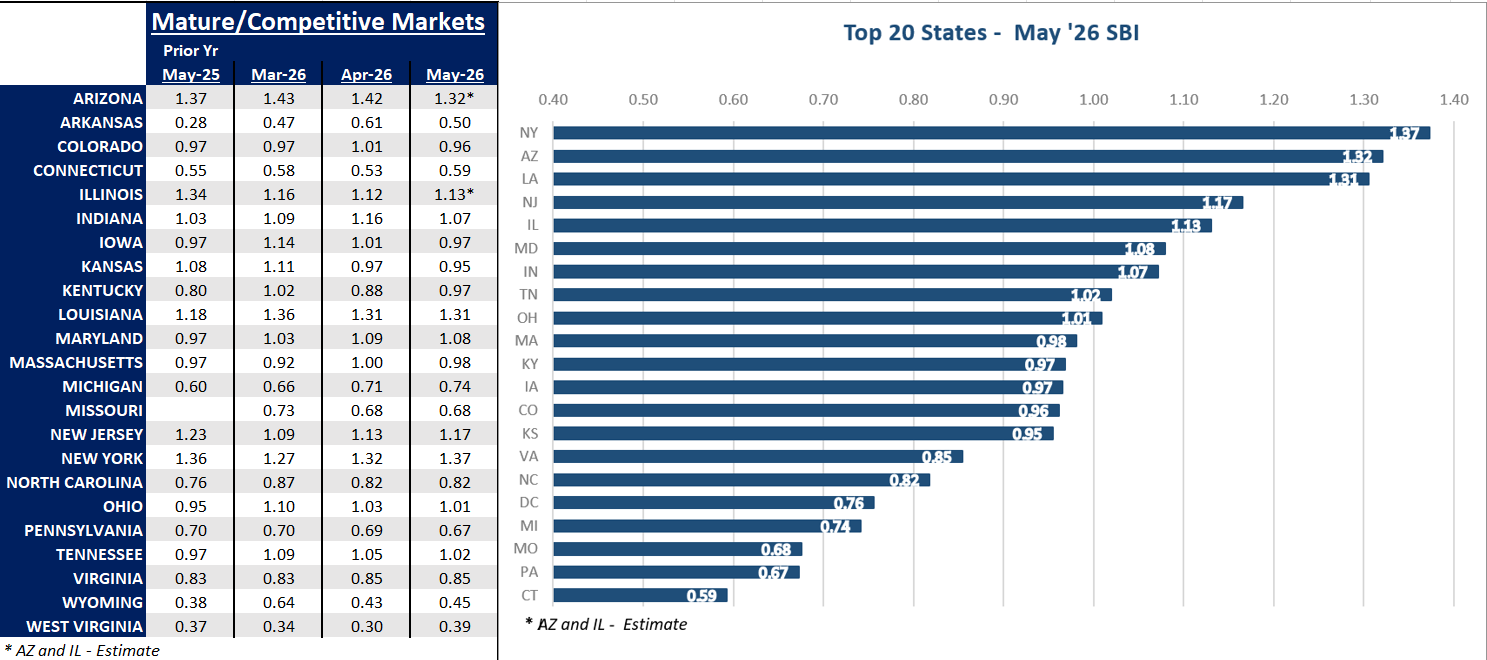
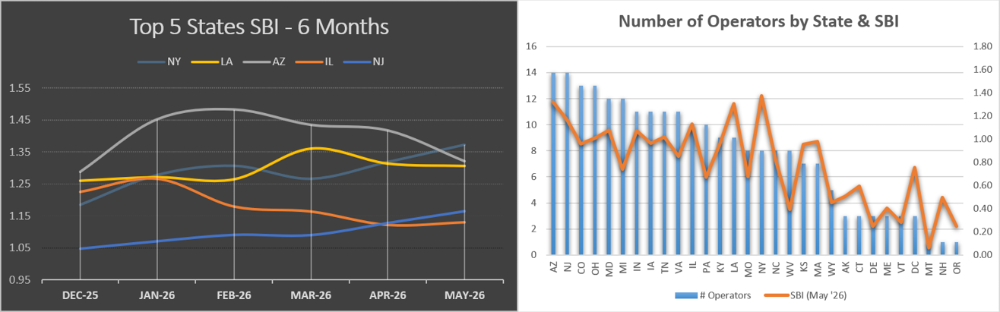
In the chart below, we present our RubinBrown Sports Betting Index (SBI). The SBI is based on our proprietary index of the leading sports betting states in the U.S. To continue to best reflect current market conditions, we’ll occasionally adjust the components of the index. To better compare competitive conditions, our index numbers focus in on a group of mature, competitive states. Therefore, a state with an index score of 1.15 had a raw index score of 15% greater than the average, while a 0.90 index score shows a 10% lower than average result.
LEARN MORE ABOUT THE RUBINBROWN SBI
Prediction Markets, Sports Betting, and the Bigger Regulatory Question
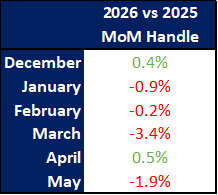
May sports betting handle revealed another overall decline across aggregate totals (excluding Missouri). While several factors can influence monthly performance, the continued softness raises a reasonable question about the impact of prediction markets on the broader sports betting ecosystem.
Regardless of where stakeholders stand on the legality of sports-related PMs, the bigger issues at hand are: who should regulate these products, why have they gained traction, and what do PMs reveal about the current structure of the U.S. sports betting market.
A Market Response, Not a New Concept
While PMs have captured headlines over the past year, the underlying concept is hardly new. Exchange-style wagering has been around under different monickers for decades in the US, Canada, and Europe. Simply put, it is the same old exchange-based wagering idea every dorm-room startup thinks they discovered. Nothing more, nothing less.
What has changed is not the product itself, but the market forces that have allowed these markets to scale.
The History
This whole conundrum began several years ago totally outside of any thought of sports betting. Legitimate cryptocurrency companies were struggling to get regulatory and legislative clarity regarding their products. Crypto.com went as far as suing the SEC, to no avail, for this clarity.
In December 2024, as an attempt to force the hand of US regulators, Crypto.com introduced Super Bowl future bets using processes and constructs of crypto trading, fiat currency, future wagers, and varying payout processes. They created ridiculous scenarios that mimicked financial products such as swaps, derivatives, futures, etc. in the hope it would force regulatory clarity on cryptocurrencies. Sports betting was the tool to gain attention, not the actual product.
Then, they were copied by Kalshi and PolyMarket and the rest is history. Today, prediction markets represent a meaningful segment of the broader wagering ecosystem. The question is no longer whether they exist, but how they fit alongside state-regulated sportsbooks.
Is the CFTC the Right Regulator?
The most important policy question is whether sports event contracts belong under the jurisdiction of the Commodity Futures Trading Commission.
The CFTC was created to oversee U.S. derivatives markets, including futures, swaps, and options, with a mission centered on market integrity, systemic risk, and protecting participants in financial markets. Those responsibilities have grown substantially as financial products have become increasingly complex.
According to their website, the mission of the Commodity Futures Trading Commission is ”to promote the integrity, resilience, and vibrancy of the U.S. derivatives markets through sound regulation.” Their market surveillance program “is intended to preserve the economic functions of futures, options, and swaps markets.”
Another key mandate is to “To protect futures markets from excessive speculation that can cause unreasonable or unwarranted price fluctuations, the Commodity Exchange Act authorizes the Commission to impose limits on the size of speculative positions in futures markets.”
At what point in reading any of this does a reasonable person think of sports betting?
Adding nationwide sports wagering oversight to that portfolio raises legitimate questions, not because prediction markets lack sophistication, but because sports betting presents an entirely different regulatory challenge than financial derivatives.
Unlike state gaming regulators, the CFTC has not historically regulated consumer wagering products involving millions of recreational participants making small-value transactions on sporting events. Expanding its responsibilities could require significant new resources and an entirely new regulatory skillset, while potentially diverting attention from its core financial market mandate.
This is less an argument against prediction markets than it is a recognition that assigning regulatory responsibility carries real consequences. If sports event contracts ultimately remain under federal oversight, Congress will eventually realize the agency lacks the resources and statutory framework necessary to regulate them effectively.
What Prediction Markets Are Telling Us
The emergence of prediction markets highlights several structural issues within regulated sports betting that deserve equal attention.- Large states including California, Texas, and Georgia remain without legal online sportsbooks despite substantial consumer demand.
- Several regulated jurisdictions have adopted tax rates exceeding 50% of gross gaming revenue, materially changing operator economics.
- Licensing costs and market access restrictions continue to limit competition and innovation in many states.
- Highly fragmented state-by-state regulation creates isolated liquidity pools that make exchange-style wagering difficult to scale.
Taken together, these conditions create incentives for alternative market structures to emerge. Rather than viewing prediction markets solely as competitors to traditional sportsbooks, policymakers may also consider them a symptom of broader inefficiencies within the existing regulatory framework.
Measuring the Actual Impact
As with many emerging products, much of the current discussion has been driven by opinions rather than data.
One of the industry's priorities should be quantifying the actual impact that prediction markets are having on regulated sports betting. Are they attracting new customers? Are they substituting for existing sportsbook wagers? Are they serving markets where regulated sportsbooks are unavailable? Or are they creating incremental engagement that benefits the broader ecosystem?
These are precisely the types of questions Sports Betting Index (SBI) intends to examine through objective market analysis rather than assumptions. Understanding where prediction market volume originates will be critical as policymakers evaluate future regulatory approaches.
Looking Ahead
Ultimately, many of today's legal questions are unlikely to be settled by industry debate alone. The courts, and potentially the U.S. Supreme Court, will ultimately determine where the jurisdictional boundaries lie between federal commodities regulation and state gaming regulation.
Until then, operators, regulators, and investors are navigating an evolving landscape where uncertainty is likely to persist.
In the meantime, there is an opportunity for states to examine whether current tax structures, licensing models, and regulatory barriers are producing the outcomes they intended. If alternative wagering products continue gaining traction primarily because portions of consumer demand remain underserved, that conversation deserves as much attention as the legal status of prediction markets themselves.
Regardless of how the jurisdictional questions are resolved, one conclusion seems increasingly difficult to dispute: the industry will be best served by regulations that provide clarity, encourage innovation, and create competitive legal markets, whether those markets ultimately fall under state gaming regulators, federal oversight, or some combination of the two.
Published: 07/10/2026
Readers should not act upon information presented without individual professional consultation.
Any federal tax advice contained in this communication (including any attachments): (i) is intended for your use only; (ii) is based on the accuracy and completeness of the facts you have provided us; and (iii) may not be relied upon to avoid penalties.