RubinBrown Sports Betting Index: November 2025 Analysis
RubinBrown Sports Betting Index: November 2025 Analysis
November 2025 Sports Betting Index (SBI)
In the chart below, we present our RubinBrown Sports Betting Index (SBI). The SBI is based on our proprietary index of the leading sports betting states in the U.S. To continue to best reflect current market conditions, we’ll occasionally adjust the components of the index. To better compare competitive conditions, our index numbers focus in on a group of mature, competitive states. Therefore, a state with an index score of 1.15 had a raw index score of 15% greater than the average, while a 0.90 index score shows a 10% lower than average result.
LEARN MORE ABOUT THE RUBINBROWN SBI
When the Noise Faded, Bettors Still Chose Legal Sportsbooks
By the time November 2025 closed, the U.S. sports betting industry had spent nearly a full year debating its own disruption. Sweepstakes platforms were pushing the edges of legality while scaling quickly. Prediction markets were attracting attention from policymakers, media, and a new class of users who didn’t think of themselves as “bettors.” Daily fantasy sports, once the gateway into regulated wagering, continued to evolve in search of renewed relevance.
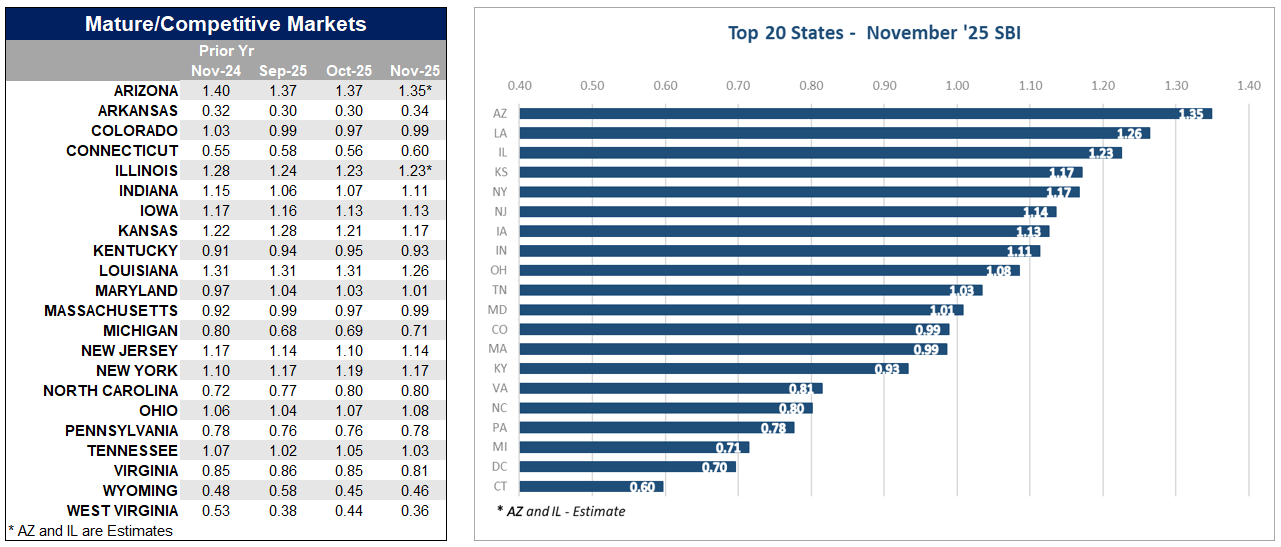
As the NFL season hit its most bet-dense stretch and basketball volumes climbed in parallel, legal sportsbooks didn’t just hold their ground, they delivered record-breaking handle in multiple states. November saw ten states posting all-time highs in handle. While Arizona and Illinois have yet to report, RubinBrown’s predictive algorithm expects all-time highs there as well.
What made these results notable wasn’t just the volume, it was the timing. These records were set in a year when operators were actively pulling back on promotions, tightening risk controls, and navigating an increasingly hostile tax environment. While the industry was working on improving their margins, bettors continued to increase their activity.
Taxation Creates Operating Leverage
Critics have argued that high taxes would eventually choke innovation, limit competition, and push customers toward less regulated alternatives. Record handle doesn’t make high taxes disappear, but it does something just as important: it creates operating leverage.
At scale, fixed costs flatten. Customer acquisition becomes less dependent on incentives. Risk models improve as data sets deepen. Parlay and in-play wagering, both margin-accretive products, perform better when liquidity is broad and diversified. In short, volume doesn’t solve the tax problem, but without volume, the tax problem has no apparent solution.
Meanwhile, the alternatives that dominated so much industry conversation throughout the year struggled to translate attention into comparable volume. Sweepstakes platforms remain constrained by legal and regulatory uncertainty. Prediction markets, while compelling in theory, lack the depth and immediacy of traditional wagering. Daily fantasy, despite its loyal user base, serves a narrower audience. These products have not failed to this point, but none have supplanted regulated sportsbooks.
Sportsbooks Remain the Choice of Consumers
When millions of consumers wanted to bet on football, they didn’t look for workarounds or abstractions. They opened sportsbook apps. They placed straight bets, built parlays, and wagered live as games unfolded. They chose familiarity, speed, and trust over novelty.
There’s an irony in that trust. Regulation and compliance can be burdensome. Taxes are, in many states, high. Yet licensed sportsbooks remain the preferred option in an increasingly robust gambling landscape. Reliable payouts, transparent rules, recognizable brands, and regulatory oversight serve as competitive advantages.
While other options may attract certain segments of the betting population due to cost or distribution advantages, online sports betting operators have largely achieved what was envisioned years ago: Capture mass market patrons with entertainment products that increase their engagement with sports.
Record high TV ratings, franchise values, and league revenues further suggest this process has been successful, albeit with some concerns that are rightfully being addressed. Our thought is, despite all the negative headlines and concerns about taxation, integrity, problem gambling, etc., regulated sportsbooks are proving to be not only resilient, but also that they have entered into a phase where scale advantages could be levered into improved operator economics.
Published: 01/12/2026
Readers should not act upon information presented without individual professional consultation.
Any federal tax advice contained in this communication (including any attachments): (i) is intended for your use only; (ii) is based on the accuracy and completeness of the facts you have provided us; and (iii) may not be relied upon to avoid penalties.