RubinBrown Sports Betting Index: October 2025 Analysis
RubinBrown Sports Betting Index: October 2025 Analysis
October 2025 Sports Betting Index (SBI)
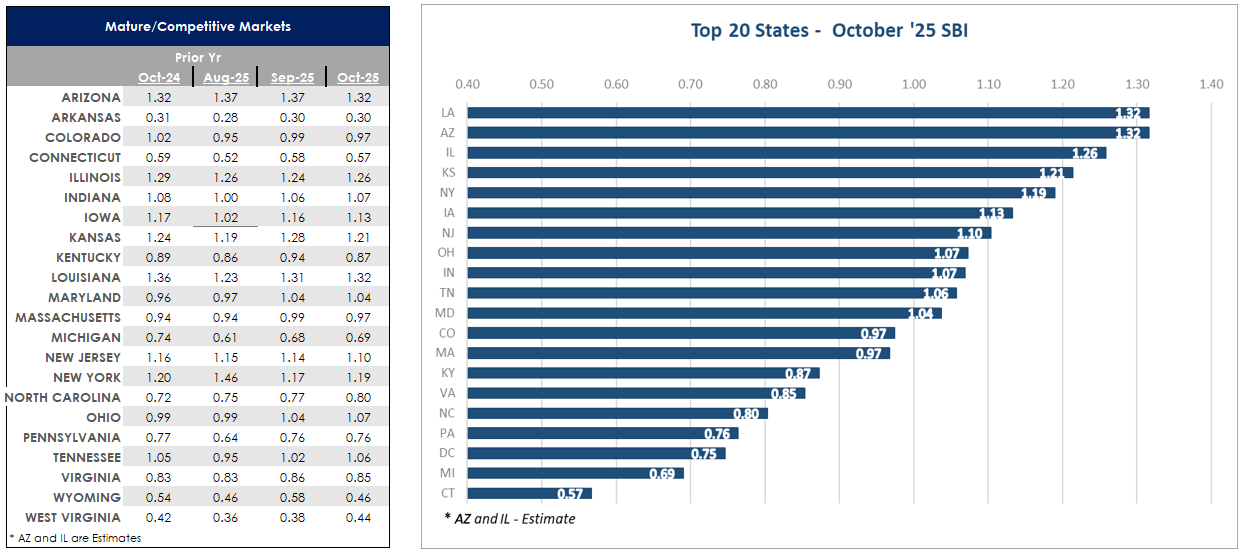
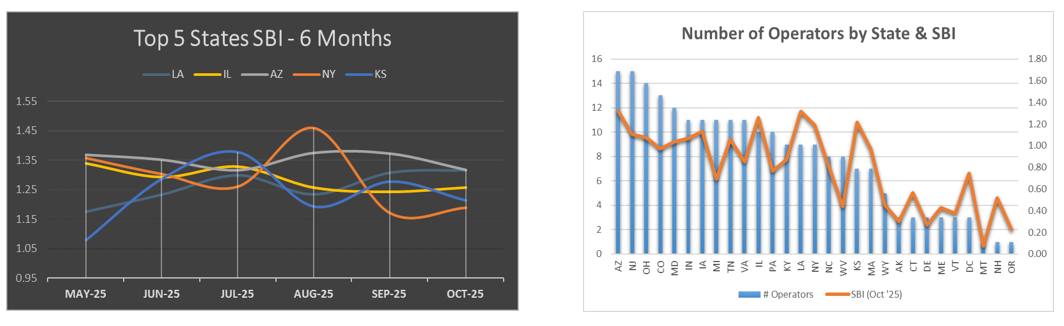
In the chart below, we present our RubinBrown Sports Betting Index (SBI). The SBI is based on our proprietary index of the leading sports betting states in the U.S. To continue to best reflect current market conditions, we’ll occasionally adjust the components of the index. To better compare competitive conditions, our index numbers focus in on a group of mature, competitive states. Therefore, a state with an index score of 1.15 had a raw index score of 15% greater than the average, while a 0.90 index score shows a 10% lower than average result.
LEARN MORE ABOUT THE RUBINBROWN SBI
October Delivers Another Month of Strong Growth
October delivered exactly what the sports betting industry expects from one of the most important months of the year: heavy football volume, steady promotional activity, and continued market momentum. National handle rose 15% year-over-year, and what makes that increase especially notable is that it was entirely organic. No new states launched during the comparable period, meaning the growth reflects genuine expansion in existing markets rather than jurisdictional lift. With nearly every state now reporting, October 2025 stands out as a month that reinforced the strength of legal markets in spite of the black and gray market headwinds, as well as an evolving taxation landscape.
The Illinois Bet-Tax Drama
Illinois’ per-wager tax officially took effect on July 1, but to capture the clearest picture of its impact, we turn to September’s data. By then, summer’s seasonal lull has ended and early shifts in bettor behavior become visible. Further, many regulated sports books implemented their responses to these taxes on September 1st. Illinois’s reported September figures provide the first snapshot of some of the implications for the state’s new per-wager tax.
Strategic responses to the tax varied. FanDuel added a 50¢ surcharge to nearly all wagers, while DraftKings created carve-outs with no surcharge on parlays of $10+, larger single bets, bonus bets, and for higher-tier loyalty accounts. Caesars, Fanatics, and others implemented 25¢ surcharges of their own, and Hard Rock Bet raised minimum wagers to $2, a quiet acknowledgment that ultra-low stakes had become economically unsustainable.
Observed Impacts on Illinois Sports Betting
Illinois bettors wagered $1.42 billion in September, a solid year-over-year increase for the kickoff to the football season. But beneath that rising handle was a sharp decline in the number of individual bets placed. Bettors were wagering more money, but far less often. The average size of a bet climbed (~28%), while total ticket count fell (~15%). It was the clearest possible signal that low-stakes, high-frequency play, the backbone of casual betting, was impacted by the new fees and minimums imposed by the sports books.
For many casual players, those placing $1 parlays or $2 bets, the economics changed overnight. Suddenly, a surcharge could represent a significant share of their stake. As a result, higher average bet sizes emerged as the new norm. High-value players kept betting while low-value players either reduced their activity or stopped altogether.
Low-cost/high-payoff wagers favored by those betting under $2 per wager generally come with much higher hold percentages. If a patron reduces or gives up making ten $1 bets that come with a 30% or higher hold and instead bets $10 on one bet with a 10% or lower hold, this will begin to add up and lead to lower realized revenues and taxes from this segment of the patron base.
Additional Competitive Considerations
This behavioral pivot arrived just as prediction markets began gaining mainstream visibility. Their event contracts resemble sports betting options and can serve as an outlet for low-stakes users, especially since they are not subject to per-wager fees. But prediction markets lack one critical feature: parlays. Without sophisticated pricing engines, they cannot replicate the primary draw for casual bettors. They are not a substitute, but they are a growing pressure point.
As competitive undercurrents build, Illinois faces a policy tradeoff. The September surcharge generated a meaningful revenue windfall for the state, reinforcing the political logic behind the tax. DraftKings and FanDuel are the only two operators expected to cross the 20-million-annual-wager threshold that triggers the higher 50¢ per-wager tax rate. Between them, they remitted nearly $9 million in per-bet taxes in September alone, incremental to existing gaming revenue taxes on sports betting.
Potential Impacts in the Data
The RubinBrown Sports Betting Index (SBI) provides a demographic and market-adjusted snapshot of each state’s relative handle performance. We maintain that handle is the strongest indicator of market health, even as revenue and tax receipts remain top of mind for regulators, investors, and operators. For September, the SBI projected an Illinois index of 1.27, corresponding to a theoretical handle of about $1.45 billion. When the actual handle came in at $1.42 billion, the realized index was 1.24.
In other words, while Illinois posted a 9% YoY gain in reported handle, the SBI indicates a 2.36% theoretical erosion once demographic and market factors are normalized, a leading indicator that operator-imposed surcharges and minimums are reshaping bettor participation.
In the end, September 2025 delivered a clear message: the per-wager tax is more than a line item. It’s a structural force reshaping how Illinoisans bet, how operators compete, and where casual players choose to spend their entertainment dollars. How these impact regulated sports betting in Illinois and in other states will be a factor in how we at RubinBrown help our clients evolve, adjust, and grow in a challenging environment.
Published: 12/22/2025
Readers should not act upon information presented without individual professional consultation.
Any federal tax advice contained in this communication (including any attachments): (i) is intended for your use only; (ii) is based on the accuracy and completeness of the facts you have provided us; and (iii) may not be relied upon to avoid penalties.