RubinBrown Sports Betting Index: September 2026 Analysis
RubinBrown Sports Betting Index: September 2026 Analysis
September Sports Betting Index (SBI)
In the chart below, we present our RubinBrown Sports Betting Index (SBI). The SBI is based on our proprietary index of the leading sports betting states in the U.S. To continue to best reflect current market conditions, we’ll occasionally adjust the components of the index. To better compare competitive conditions, our index numbers focus in on a group of mature, competitive states. Therefore, a state with an index score of 1.15 had a raw index score of 15% greater than the average, while a 0.90 index score shows a 10% lower than average result.
LEARN MORE ABOUT THE RUBINBROWN SBI
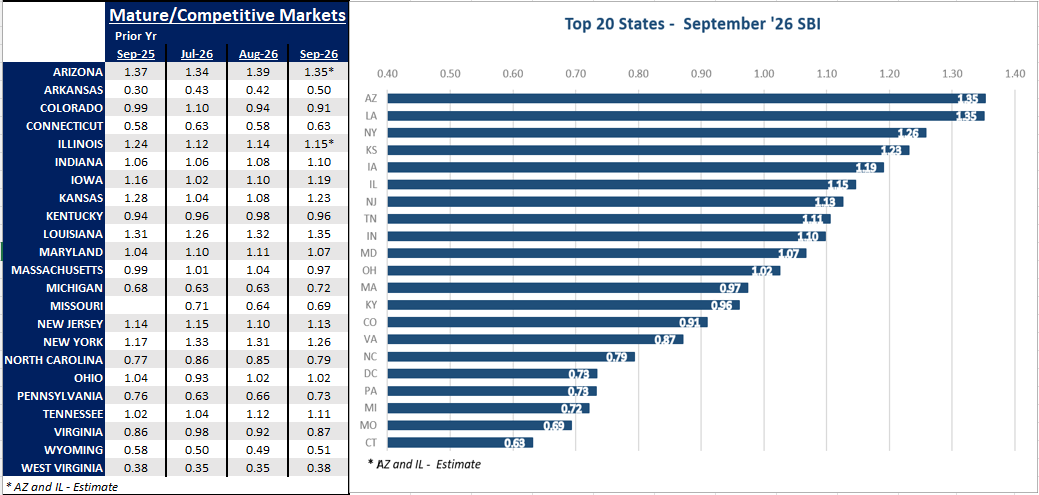
If you listened to some of the more prominent industry commentary over the past several months, you might have concluded that the regulated sports betting industry was facing an existential threat from the rapid growth of prediction markets. September's results, however, offered a different perspective. Despite the continued expansion of prediction markets and a less favorable NFL calendar (one fewer NFL weekend in September 2026 compared with 2025), regulated sportsbooks delivered strong handle numbers, challenging predictions of an industry losing momentum.
The results underscore the resilience of state-regulated sports betting and the strength of an established consumer market built around localized engagement, familiar wagering products, and increasingly sophisticated risk management. While alternative platforms are attracting attention and introducing new forms of event-based trading, September's performance suggests their growth has not come solely at the expense of traditional sportsbooks to the extent some commentators have suggested.
Absorbing the Headwinds: Calendar Shifts and Market Competition
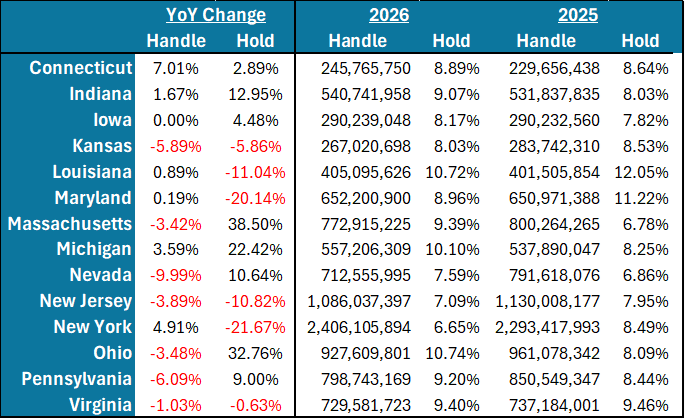
Despite the calendar disadvantage, several major markets posted encouraging results. New York surpassed $2.4 billion in handle, representing nearly 5% year-over-year growth. Other established markets, including Connecticut (+7.01%), Michigan (+3.59%), and Indiana (+1.67%), also recorded positive handle growth.
The September numbers suggest that consumer demand for regulated sports betting remains relatively durable, even as the competitive landscape evolves. Prediction markets may appeal to a different segment of consumers, particularly those interested in event-based contracts, financial-style trading, or opportunities to speculate on outcomes beyond traditional sports wagering. However, the continued strength of sportsbook handle indicates the established mobile betting experience, including its depth of betting options, live wagering, parlays, and integration with professional sports, continues to attract substantial consumer activity.
Hold Declines Are Not Necessarily the Result of Prediction Markets
A separate narrative gaining traction among financial commentators and industry analysts suggests that prediction markets are beginning to cannibalize sportsbook profitability. The argument is that bettors migrating toward exchange-based contracts are influencing pricing and reducing traditional sportsbook margins, with New York's September year-over-year hold decline frequently cited as evidence of a broader industry trend.
There are two problems with this interpretation. First, it places too much weight on a single state's monthly results. Second, it risks confusing normal sportsbook revenue volatility with a structural change in consumer behavior.
New York is the country's largest regulated sports betting market, but its size also makes monthly hold particularly susceptible to localized betting patterns and game outcomes. The concentration of wagers around popular teams can produce significant swings in operator results, particularly when heavily backed teams outperform expectations. A decline in hold under these circumstances does not necessarily indicate a deterioration in operator pricing or a migration of customers to competing platforms.
Consider June 2026, when New York sportsbooks recorded approximately 5% hold amid the Knicks' run to an NBA championship. That result was largely a reflection of betting outcomes and public wagering patterns, not evidence of prediction markets disrupting sportsbook margins. The same analytical discipline should apply when interpreting an unfavorable month. One cannot reasonably attribute positive or negative hold movements to structural market changes without accounting for the underlying results that produced them.
The broader market data reinforces this point. As the chart below illustrates, reported hold results across several of the largest states varied considerably, ranging from New York's decline of 21.67% to Massachusetts' increase of 38.50%. Such a wide dispersion in monthly results is consistent with the inherent volatility of sportsbook hold and makes it difficult to identify a common industry-wide trend based on isolated state results.
Variance, Not Necessarily Cannibalization
The same distinction applies to other jurisdictions reporting lower hold. Sportsbook hold is inherently sensitive to event outcomes, the composition of wagers, promotional activity, and the relative performance of different betting products. These factors can create substantial short-term fluctuations in market specific hold percentages.
Meanwhile, regulated sportsbooks continue to refine their pricing models, manage exposure across increasingly complex betting menus, and expand higher-margin products such as same-game parlays and live in-play wagering. These capabilities, combined with established customer relationships and a broad range of regulated betting options, remain meaningful competitive advantages.
None of this suggests that prediction markets can be dismissed as a competitive influence. Their continued growth warrants attention, particularly as their products, distribution, and regulatory positioning evolve. However, September's results provide a great reminder that the growth of an alternative market does not automatically translate into a corresponding decline in traditional sports betting. For now, regulated sportsbooks appear to be absorbing the additional competitive noise while continuing to demonstrate the underlying strength and adaptability of their business models.
Published: 11/16/2026
Readers should not act upon information presented without individual professional consultation.
Any federal tax advice contained in this communication (including any attachments): (i) is intended for your use only; (ii) is based on the accuracy and completeness of the facts you have provided us; and (iii) may not be relied upon to avoid penalties.