Back to Insights
Show-Me the Stakes: Missouri's Strategic Entry into Sports Betting
Show-Me the Stakes: Missouri's Strategic Entry into Sports Betting
Missouri's Strategic Entry into Sports Betting
After years of legislative gridlock and a razor-thin margin at the ballot box, RubinBrown’s home state of Missouri officially launched its legal sports betting market on December 1, 2025. The "Show-Me State" is no longer a spectator in the national sports wagering expansion, moving to capture tax revenue that has long leaked across its borders to neighbors like Kansas and Illinois.For operators, Missouri’s competitive tax rate and unique "promotional cap" provide an attractive new opportunity. Meanwhile, the State aims to avoid the revenue "black holes" seen in other markets luring operators and bettors away from high-tax neighbors.
The Inaugural Results
The month of December clocked in above many expectations at just over $542M in handle ($543M total, less voids/cancels). At the forefront were mobile market stalwarts FanDuel ($212.7M) and DraftKings ($195.3M), contributing over 75% of that total.In terms of consumer preferences, parlays led the way in all categories. These multi-leg bets accounted for roughly 56% of wagers placed, 40% of handle, and created over 71% of the overall GGR on 35% hold. Incorporating all wager categories, Missouri’s market produced a healthy 19.21% total hold; an especially notable result given that betters redeemed more than $125 million in free bets during the launch period.
It should be noted that, after promotional deductions, the state reported “Total Taxable Gross Revenue” of -$20.76M (the chart below was posted by the Missouri Gaming Commission). The state did collect tax revenue of $88,733 from retail operators, and an additional $432,467 from the four mobile operators who did not have enough promotional bet deductions to offset all their GGR.
.png "Missouri-Gaming-Commission-(1).png")
Return of Border-Crossers
Based on geo-compliance data, Kansas and Illinois had historically captured meaningful wagering activity from Missouri residents. As Missouri’s market comes online, a key dynamic to monitor will be the repatriation of that handle as bettors no longer need to cross state lines to place wagers.While Illinois data is not yet available, Kansas results provide an early reference point, with handle declining 7.8% year-over-year, from $261.2 million to $240.7 million. Given the Kansas City Chiefs’ earlier-than-usual exit from playoff contention, it would be premature to draw firm conclusions from a single month of data. That said, the Missouri–Kansas–Illinois corridor will be an important relationship to watch as additional months of post-launch data become available.
A Comparative Tax Tale
The December results for tax revenue were a bit underwhelming, but we expect that to be temporary. Due to the expected aggressive promotional deductions in a market launch, the state collected a mere $521,200 in tax on $104M in GGR, for an effective rate of 0.5%. Additionally, there are roughly $26M in operator AGR loss carryovers for future months. As promotional spend moderates to the normal range of 2-4% of handle, we expect the effective tax rate to settle around 8% of GGR.Missouri’s 10% flat tax on Adjusted Gross Revenue (AGR) is intentionally competitive. Unlike Kansas, where unlimited promotional deductions can result in a monthly effective tax rate below 4%, Missouri caps these deductions at 25% hoping to ensure a steady stream of revenue for public education.
This strategy may also be construed as a direct challenge to Illinois, which recently moved to a graduated tax system that, when combined with per-wager fees, can push the effective burden for major Illinois operators, up to about 40 %.
How Missouri Put Itself in the Sweet Spot
Missouri’s launch featured a "controlled competitive" environment. While the state has authorized up to 14 online licenses, it went live with 8 active operators with a focused lineup of major brands, including Circa, FanDuel , DraftKings, and BetMGM. Based on RubinBrown’s analysis, Missouri’s launch positions the state in a strategic "sweet spot" that balances consumer choice with market stability.We note that this also represents a marketplace choice, as Missouri would likely have approved more suitable operators had they applied with the allowed partners.
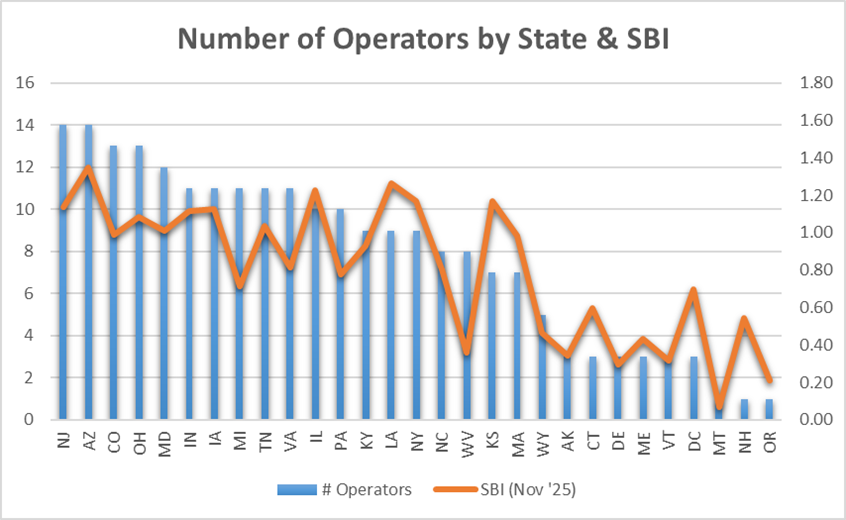
As shown in the chart below, states with excessive operator counts, such as New Jersey, Arizona, or Colorado, often face high levels of churn as smaller books struggle to compete with national giants. Conversely, Missouri avoids the stagnation of limited-competition markets and lottery-run monopolies where fewer players can lead to less aggressive promotional spending.
Missouri bettors have access to the industry’s most competitive odds and sophisticated mobile apps without the "market fatigue" that occurs when too many platforms dilute the available player base. This moderate density allows the state to maintain a healthy SBI (Sports Betting Index) and mirror top-tier performers which have demonstrated that a curated field of roughly 7-10 operators can generate massive handle without sacrificing quality of service.
Hope for the Future: A Home Field Advantage
Missouri’s impetus for continuing this momentum is with a formidable "home team" portfolio, particularly within the professional ranks, which serves as a massive engine for betting handle. The state boasts six major professional franchises that anchor the sports calendar, ranging from the dynasty-building Kansas City Chiefs in the NFL to the historic summer tradition of the St. Louis Cardinals and Kansas City Royals in MLB. The winter months are fueled by the St. Louis Blues (NHL), while the state’s burgeoning soccer culture is represented by the high-octane atmosphere of St. Louis CITY SC (MLS) and the trailblazing Kansas City Current (NWSL). The only lacking pro sport is the NBA, where Missouri stands as the 4th largest market that does not field a team.While the professional scene is elite, the college betting landscape presents a hurdle. The University of Missouri (Mizzou) has long stood as the state's lone representative at the highest level of college football. That changed in 2025 when Missouri State University officially began its transition to the FBS, joining Conference USA.
Without an NBA presence, basketball action would focus on the college landscape which, unlike several markets, allows wagers on in-state teams (sans player props). Missouri boasts 6 D1 programs across 5 tournament-eligible conferences. While formidable, Missouri’s college market still lacks the sheer density found in neighboring states like Illinois with 12 D1 teams.
A Conclusive First Month
As Missouri moves into its first full year of legal wagering, the early data confirms what the RubinBrown Sports Betting Index (SBI) signaled months ago: the "Show-Me State" is not just another entrant in the national market. By generating $543 million in handle, Missouri has proven that the demand for a localized, regulated environment was even higher than initial baseline estimates suggested.For operators and stakeholders, the successful December launch reinforces the value of Missouri’s "sweet spot" competitive density. With eight major brands delivering high-quality user experiences without the cannibalization of an over-saturated field, the market is primed for long-term sustainability. At RubinBrown, we will continue to leverage our proprietary SBI to track this evolution, providing the clarity needed to navigate a landscape that, while still in its infancy, is already outperforming expectations. Missouri has officially moved from a "spectator" state to a national leader in strategic gaming.
Published: 02/05/2026
Readers should not act upon information presented without individual professional consultation.
Any federal tax advice contained in this communication (including any attachments): (i) is intended for your use only; (ii) is based on the accuracy and completeness of the facts you have provided us; and (iii) may not be relied upon to avoid penalties.