Sports Betting Index: August 2026 Analysis
Sports Betting Index: August 2026 Analysis
August Sports Betting Index (SBI)
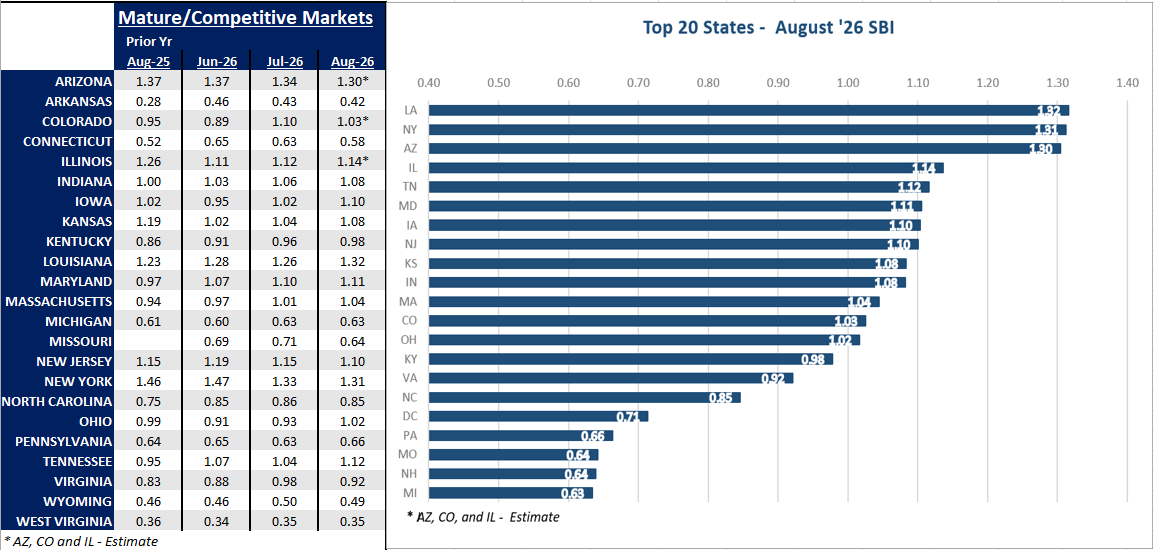
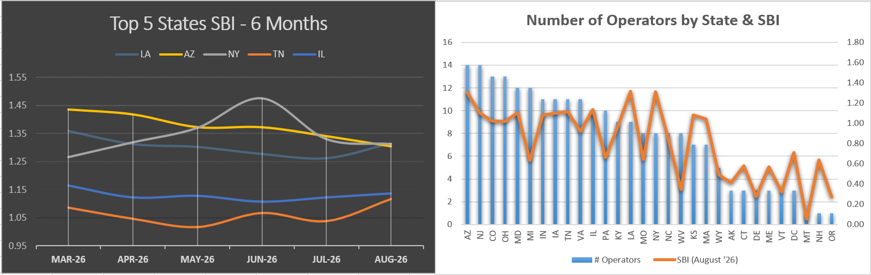
In the chart below, we present our RubinBrown Sports Betting Index (SBI). The SBI is based on our proprietary index of the leading sports betting states in the U.S. To continue to best reflect current market conditions, we’ll occasionally adjust the components of the index. To better compare competitive conditions, our index numbers focus in on a group of mature, competitive states. Therefore, a state with an index score of 1.15 had a raw index score of 15% greater than the average, while a 0.90 index score shows a 10% lower than average result.
Can’t We All Just Get Along?
In a truly healthy ecosystem, high-touch retail convenience and raw wholesale efficiency don't just coexist; they complement one another. When applied to sports betting, it means the growing presence of prediction markets alongside traditional sportsbooks does not necessarily need to be viewed as a winner-take-all contest between competing approaches. Rather, the two models serve different consumer needs, with differences in pricing, market structure, and how each platform manages transactions. Framing the relationship as an “either/or” choice risks overlooking the potential benefits of allowing multiple models to develop and compete within a well-defined regulatory framework.
The issue facing sports betting isn't that two different business models exist to serve two different types of consumers, but that an uneven tax and regulatory landscape is preventing them from competing on a genuinely level playing field.
The Corner Store, the Warehouse Club, and the $4.50 Gallon of Milk
It’s a freezing rainy Tuesday. You pop into the 7-Eleven on the corner, grab a gallon of milk from the glass cooler, hand over $4.50, and walk out the door in less than ninety seconds.
You know for a fact that if you drove twenty minutes down the highway to a warehouse club, that exact same gallon of milk costs $3.10. Yet you don't feel cheated. You paid the premium willingly because you didn't want to navigate a massive warehouse, buy in bulk, or stand in a forty-minute checkout line just to splash some milk into your morning coffee. You paid for instant access, guaranteed stock, and frictionless convenience.
Now, take a look at the sports betting landscape.
When a bettor logs onto FanDuel or DraftKings and sees a standard NFL point spread priced at -110 / -110, they are standing at the counter of that corner 7-Eleven. That `-110` price tag represents a 4.55% theoretical house edge (hold). When that same bettor looks at a prediction market like Kalshi offering binary contracts with a paper-thin 1.0% to 1.5% fee margin, they are looking through the glass at the warehouse club.
At first glance, the outrage seems justified: “Why are traditional sportsbooks charging us four times as much for the same game?”
The answer is simple: They aren't selling the same product. And more importantly, both of these business models can, and should, coexist peacefully. The real threat to the industry isn't that a corner store charges more than a wholesale depot; it's that state and federal regulators are forcing them to play under two completely different sets of rules.
To understand why the price gap exists, we need to acknowledge that free markets must reward risk higher than they reward facilitation, or nobody will take on risk.
7-Eleven Model: Paying $4.50 for Guaranteed Milk
That 4.55% sportsbook edge pays for the house to take on principal risk. Just like the corner store buys milk ahead of time with its own capital and absorbs the loss if it spoils on the shelf, DraftKings acts as the direct counterparty to your bet. They guarantee instant execution up to posted limits the second you tap your screen. If sharp money floods in on an injured quarterback, the house eats the variance. The wider margin is an insurance premium for guaranteed liquidity.
The Wholesale Club Model: Trading at $3.10 on the Floor
On a prediction market, a binary event is priced natively at 50¢ for "Yes" and 50¢ for "No". A perfect implied probability market. The platform doesn't make money by setting prices; it charges a tiny fee (typically 1.0% to 1.5%) on transactions or settled winnings.
Why can they charge so little? Because the exchange takes zero risk. They aren't the store selling you milk; they are simply the roof over the farmers' market. They match Buyer A with Seller B. If you want to place a $500 bet on an obscure player prop and no peer or market maker is sitting on the other side of the order book, your bet doesn't get placed. You get raw wholesale pricing, but you give up guaranteed fulfillment.
The Regulatory Rigging: A Town with Two Tax Codes
Consumers need both of these spaces. The casual bettor watching Sunday Night Football wants pre-packaged Same Game Parlays, live cash-outs, and a seamless app that fills orders in milliseconds. The high-volume, price-sensitive trader needs tight spreads, order books, and minimal transaction drag.
The crisis brewing in the industry today is that government policy treats them as if they live in entirely different dimensions.
Imagine a town mayor declaring that the corner 7-Eleven must pay a 51% retail tax on every gallon of milk sold, while allowing the warehouse club down the road to pay zero percent in state taxes simply because it registered under a federal commodities trade license.
That is the exact state of play in American wagering. Traditional sportsbooks pay a punishing tax on Gross Gaming Revenue (GGR), along with other massive fees for the privilege of operating in each state. Meanwhile, CFTC-regulated prediction exchanges operate on a federal framework that completely bypasses state gaming taxes and local regulatory fees.
If a sportsbook tried to drop its vig down to prediction market levels and pay those fees and GGR tax rate, it would go bankrupt before halftime.
A Fair Highway for Both Vehicles
The goal for lawmakers and industry leaders shouldn't be to crush prediction markets to protect legacy sportsbooks, nor should it be to let exchanges run tax-free rings around state-regulated books. The goal should be a level playing field:
- Harmonized Fees and Revenue Taxes: If a platform profits from people wagering on event outcomes, whether through a bookmaker's hold or an exchange's transaction fee, it should pay an equitable rate into state coffers.
- Standardized Consumer Protections: Both models should adhere to identical responsible gaming protocols, identity verification, and integrity monitoring.
- Product Cross-Pollination: State frameworks should give traditional sportsbooks a clear path to launch peer-to-peer exchange pools, while giving prediction markets a standardized route into state-level retail ecosystems.
Customers should be able to choose between the instant speed of the corner shop and the raw pricing of the warehouse club. But as long as the tax code favors one over the other, the game isn't being played on a level field.
Published: 10/19/2026
Readers should not act upon information presented without individual professional consultation.
Any federal tax advice contained in this communication (including any attachments): (i) is intended for your use only; (ii) is based on the accuracy and completeness of the facts you have provided us; and (iii) may not be relied upon to avoid penalties.