Sports Betting Index: July 2026 Analysis
Sports Betting Index: July 2026 Analysis
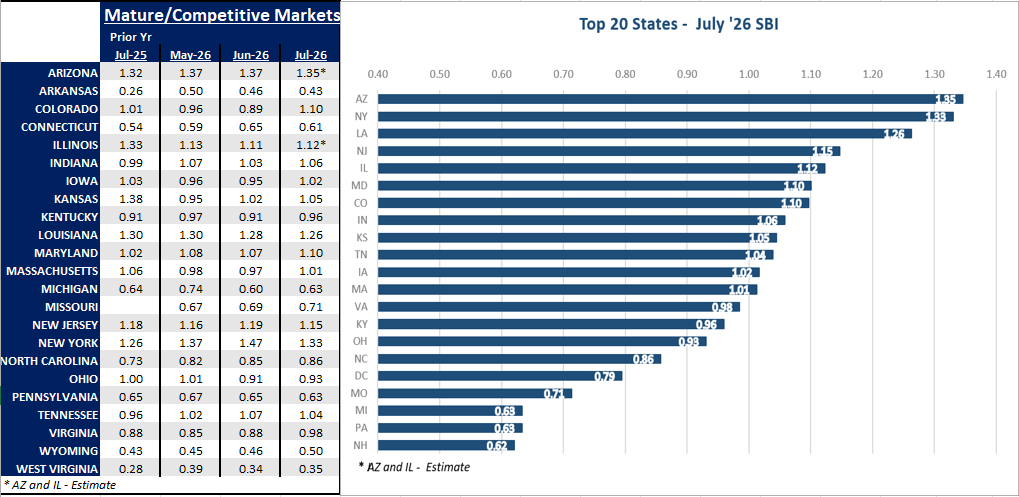
July Sports Betting Index (SBI)
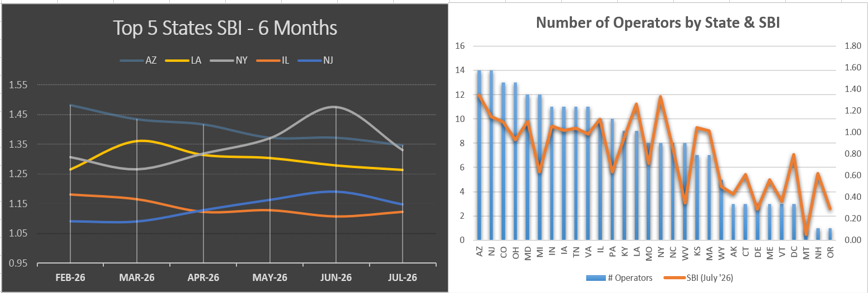
In the chart below, we present our RubinBrown Sports Betting Index (SBI). The SBI is based on our proprietary index of the leading sports betting states in the U.S. To continue to best reflect current market conditions, we’ll occasionally adjust the components of the index. To better compare competitive conditions, our index numbers focus in on a group of mature, competitive states. Therefore, a state with an index score of 1.15 had a raw index score of 15% greater than the average, while a 0.90 index score shows a 10% lower than average result.LEARN MORE ABOUT THE RUBINBROWN SBI
Stop Calling Prediction Markets the “Wisdom of Crowds”
Many have been promoting prediction markets saying they work because they harness the “wisdom of crowds”. Put enough people into a market, let them “predict” something and the market will arrive at a wiser prediction.
It is an appealing story that gives prediction markets an intellectual legitimacy. There is only one problem: a prediction market is not the classic “wisdom of crowds” experiment. Put a jar full of gumballs in front of a group of people and ask each person to estimate how many are inside. Individual guesses may be inaccurate but average them together and the result can be surprisingly close to the correct answer. Independent judgments can collectively produce a better answer than many of the individuals who make up the group.
That is the wisdom of crowds. Now change the rules. Instead of asking people for their estimates, let them put money behind their answers. Allow them to buy and sell, see prices others are paying, increase their positions when they become more confident and profit when they are right. At that point, the experiment has changed. You no longer have a crowd offering independent judgments. You have a market.
Once Money Is Involved, People Aren't Just Giving Their Opinions
Ask 10,000 people who they think will win a football game and you are collecting opinions. Ask those same 10,000 people to put $100 behind their answers and you are doing something very different. The introduction of money changes the incentives. Information matters, bankroll matters, risk tolerance matters and, most importantly, price matters. The crowd of 10,000 will thin out quickly to just those who want to participate and most will think their opinion is informed.
A bettor might believe a team has a 55% chance of winning and happily buy a contract at 50 cents, while refusing to buy that same contract at 57 cents. Nothing about the bettor's underlying opinion has changed but the economics of the decision have. That is not how the gumball-jar experiment works.
The Crowd Isn't Independent
There is another problem with the “wisdom of crowds” label: sports bettors are not operating in isolation. Increasingly, they use the same data, statistics and, in some cases, the same models. They also watch each other. If a star quarterback is ruled questionable and 5,000 people immediately change their positions, that does not represent 5,000 independent pieces of information. It is essentially one piece of information transmitted throughout the market.
If participants react to the same information in the same way, the crowd may be large, but it is no longer independent. Modern markets encourage this interaction: traders see prices move, interpret those moves and attempt to determine whether someone else knows something they don't. The prediction market isn’t worried about who knows more. It just wants more people to have a strong enough opinion to be willing to participate.
A Market Price Is Not an Average Opinion
A market price reflects the interaction of “information”, which boils down to expectations about what not just the event participants will do, but what other market participants will do. The resulting price is an equilibrium between buyers and sellers, no longer an “opinion”.
The crowd isn't voting, its trading. And the person with access to the best information (sometimes to the degree it is “insider information”), or the greatest willingness and ability to act on it, may have considerably more influence on the market than hundreds or even thousands of casual participants. That may be why markets can work so well.
A professional bettor isn't always trying to predict a market either. The professional identifies situations in which the market price does not accurately reflect the probability of an event. That is a different concept from asking a crowd to estimate the number of gumballs in a jar and averaging their answers. The more sophisticated the market becomes, with professional traders, quantitative models, market makers and arbitrageurs, the less appropriate it becomes to describe the resulting price as just crowd wisdom. In a prediction market, the knowledgeable person probably would realize giving their opinion on the gumball jar is a waste of their time if they can’t profit from it.
None of This Means Prediction Markets Don't Work
Research has found that prediction markets can outperform polls and other forecasting methods under certain conditions, and sports betting markets can incorporate information extremely efficiently. People with valuable information have a reason to act on it, creating a powerful system for discovering and incorporating information. In that sense, “information market” may be a far more accurate description than “wisdom of crowds.”
The market does not simply ask people what they think; it asks them what they are willing to do with what they think. That is a much more demanding test than asking a person passing by to guess how many gumballs are in a jar.
Published: 09/15/2026
Readers should not act upon information presented without individual professional consultation.
Any federal tax advice contained in this communication (including any attachments): (i) is intended for your use only; (ii) is based on the accuracy and completeness of the facts you have provided us; and (iii) may not be relied upon to avoid penalties.